


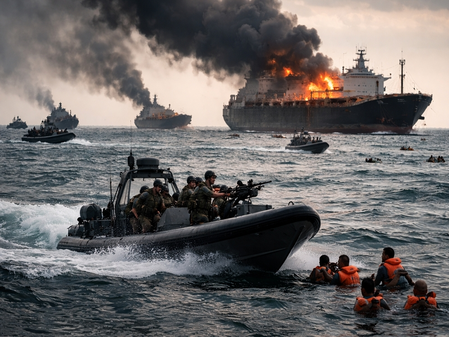
The maritime security situation in the Persian Gulf, Strait of Hormuz, and Gulf of Oman has significantly deteriorated. Recent reports from the Information Fusion Centre-Indian Ocean Region highlight a surge in attacks on commercial shipping amidst ongoing military tensions. These incidents have resulted in the loss of five lives, with casualties reported from various vessels including Hercules Star, Stena Imperative, and Ocean Electra.
At least three Indian seafarers serving on foreign-flagged ships have been confirmed dead, and one more injured. However, there have been successful rescue operations, with sixty-nine individuals saved from affected vessels. Notable rescues include crews from Libra Trader, LCT Ayeh, Safeen Prestige, Gold Oak, and MKD Vyom.
Ten vessels have been directly targeted by projectiles, missiles, or drones, while three other incidents involved explosions in close proximity. The affected ships, such as Hercules Star and Stena Imperative, are mainly concentrated around UAE waters and Bahrain approaches. Significant disruptions like GNSS and GPS jamming, along with AIS irregularities, continue to impede navigation in the region.
Vessel movements through the Persian Gulf have drastically reduced, leading to almost a standstill in traffic through the Strait of Hormuz. This choke-point typically handles about twenty percent of the world’s seaborne oil traffic. Due to the heightened risks, many shipping companies are opting for longer alternative routes, facing increased insurance costs. Indian authorities report thirty-seven Indian-flagged ships with over one thousand seafarers stranded in the affected waters.
The Indian Navy, Ministry of External Affairs, Information Fusion Centre-Indian Ocean Region, and Maritime Rescue Coordination Centres are closely monitoring the situation and providing necessary assistance. The Information Fusion Centre-Indian Ocean Region advises all merchant vessels to adhere to the Best Management Practices for Maritime Security and adjust them as needed. The situation remains volatile, with potential for further escalation, posing risks to global energy supply chains and the safety of seafarers in the region.
