


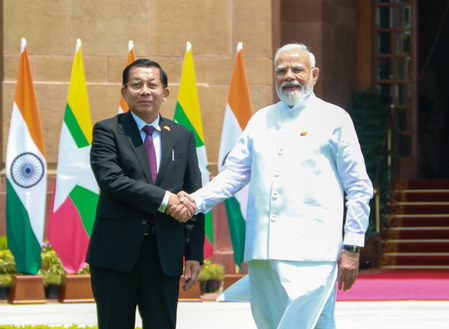
Myanmar’s President U Min Aung Hlaing visited India recently, aiming at strategic considerations. Despite ties with China, Myanmar seeks a counterbalance through broader regional engagement, viewing India as a partner without sovereignty concerns linked to China. The visit marked U Min Aung Hlaing’s first foreign trip since assuming office in April 2026, signifying Naypyidaw’s efforts to reduce China’s influence and recognize India’s openness policy.
Myanmar has faced isolation since the 2021 military takeover, with Western nations and most ASEAN members condemning the junta. China has emerged as Naypyidaw’s primary economic and diplomatic ally, focusing on projects like the China-Myanmar Economic Corridor to access the Indian Ocean. In contrast, India maintains engagement with Myanmar, emphasizing sustained dialogue over political commentary, as stated by Foreign Secretary Vikram Misri following talks on June 1.
During discussions between Prime Minister Narendra Modi and President Min Aung Hlaing, both countries agreed to enhance cooperation in various sectors, including trade, investment, connectivity, and border management. India’s approach involves engaging with Myanmar’s central government and opposition groups, viewing political fragmentation as a reality to manage rather than a conflict to take sides in, leading to strategic benefits and strengthened regional partnerships.
The report contrasts India’s approach with ASEAN’s non-engagement stance towards Myanmar, highlighting the benefits of sustained dialogue and dual-track diplomacy. India’s strategic engagement with Myanmar, evident from the recent visit, challenges China’s dominance in critical minerals and positions New Delhi as a favored regional partner, showcasing a credible claim to regional leadership through the Act East policy.
