


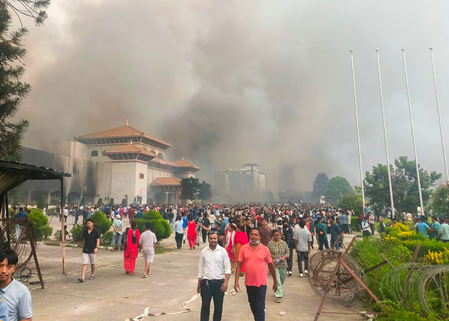
Activists associated with Nepal’s Gen-Z movement are staging ongoing protests in Kathmandu, urging the government to disclose a report from a probe commission investigating the September 8-9 incidents that resulted in multiple fatalities. The commission, headed by former Justice Gauri Bahadur Karki, submitted its findings to the current government led by interim Prime Minister Sushila Karki on March 8.
The demonstrators are pressing for the publication of the highly anticipated Karki Commission report, which many believe could reshape the country’s accountability system. Established on September 21, 2025, the commission was tasked with examining the crackdown on the Gen-Z protest on September 8, 2025, as well as the subsequent acts of vandalism and arson.
The deadline for the commission’s work was extended multiple times after it exceeded the initial three-month timeframe. The interim government is hesitant to rush the report’s release due to concerns over national security and sensitivity surrounding its contents. This cautious approach has sparked a wave of activism, particularly among Nepal’s youth, who view the delay as an evasion of accountability by the state.
A senior government official hinted that the report is likely to be handed over to the incoming government, which is expected to take office soon. Following recent elections, the Rastriya Swatantra Party (RSP) emerged victorious, with engineer-rapper Balendra Shah poised to become the new prime minister. Shah’s social media influence played a significant role in mobilizing the Gen-Z protestors, who voiced grievances over unemployment, corruption, and political inertia.
The new government is anticipated to address the fate of the probe report, which is rumored to implicate senior figures in endorsing excessive force. The interim government’s reluctance to release the report is perceived as an attempt to maintain a fragile peace. While officials argue that disclosure could stoke tensions and be exploited by adversaries, critics view this stance as an evasion of accountability.
Protestors persist in demanding the report’s publication at the Maitighar Mandala monument in central Kathmandu. The demonstrations have garnered support from civil society, legal professionals, and academics, who argue that withholding the report undermines democratic principles. The controversy has attracted international scrutiny, with human rights groups urging Nepal to uphold democratic values by releasing the report.
For many in Nepal, the Karki Commission report symbolizes a pivotal moment for the state to address its shortcomings. The delay has transformed the report into a symbol of transparency, uniting diverse factions in a call for accountability.
