


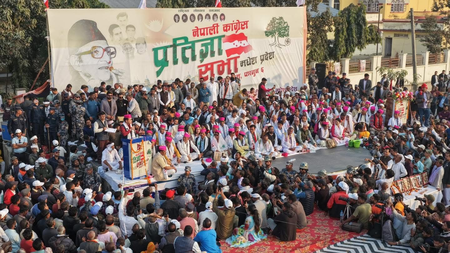
As Nepal prepares for the upcoming March 5 General Elections, the country’s key political players, including the Nepali Congress, Communist Party of Nepal–Unified Marxist Leninist, and Rastriya Swatantra Party, have revealed their distinct foreign policy priorities. The Nepali Congress and CPN-UML, with established foreign policies, are joined by the Rastriya Swatantra Party, introducing its stance as it aims to lead the next government. The RSP advocates for a “balanced and dynamic diplomacy,” aiming to transform Nepal from a “buffer state” into a “vibrant bridge” through enhanced regional connectivity and trilateral economic partnerships, particularly with India and China.
In its election manifesto, the RSP emphasizes the strategic importance of Nepal in the context of India and China’s interests and global power shifts. The party stresses the necessity for Nepal to adapt a proactive and flexible diplomatic approach to leverage evolving geopolitics and the economic rise of neighboring countries. The RSP also highlights the potential for Nepal to benefit from India’s advancements in various sectors over the past decade, such as digital infrastructure, physical development, and economic formalization.
The Nepali Congress, in its manifesto, asserts a commitment to a foreign policy that avoids involvement in defense conflicts and strategic rivalries among major powers. Emphasizing the principle of maintaining friendly relations with all nations based on equality and mutual benefit, the party prioritizes Nepal’s national interest above all else. Similarly, the CPN (UML) reiterates its foreign policy doctrine of “friendship with all, enmity with none,” pledging to enhance cooperation with neighboring countries and engage more deeply with the international community. Under its leadership, the CPN (UML) vows not to undertake actions that could harm the interests of its neighbors.
