


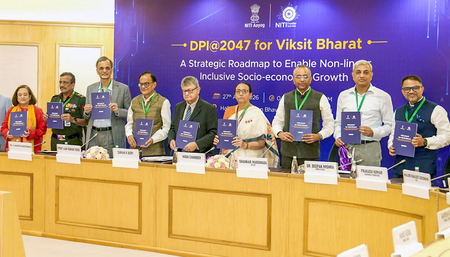
NITI Aayog has introduced a strategic roadmap outlining the future of India’s Digital Public Infrastructure (DPI) journey towards inclusive and productivity-driven growth. Named ‘DPI@2047 for Viksit Bharat,’ this roadmap signifies a significant progression in India’s digital landscape, focusing on enhancing capability, productivity, and opportunities on a large scale.
The roadmap, developed in collaboration with EkStep Foundation and Deloitte, delineates a two-phase approach for India’s digital evolution: DPI 2.0 (2025–2035) to propel livelihood-oriented growth and DPI 3.0 (2035–2047) to foster widespread prosperity, with the immediate emphasis on DPI 2.0. Under DPI 2.0, the roadmap identifies eight sectoral transformations to overcome structural challenges in areas like MSMEs, agriculture, education, and health, while reinforcing systemic support such as credit accessibility and decentralized energy.
To ensure effective implementation, the roadmap emphasizes four key execution imperatives: district-level demand aggregation, promoting technology entrepreneurship, harnessing AI, and facilitating cross-sector advancements through enhanced data utilization, digital transactions, strengthened human capacity, and AI democratization. At its core, DPI 2.0 aims to extend India’s digital infrastructure beyond basic services like identity, payments, and welfare to bolster livelihoods, productivity, and market connectivity.
This strategic approach signifies a shift towards creating growth not just through technological innovations but by establishing a connective infrastructure that enables innovation to collaborate, propagate swiftly, and reach a wider audience. By amalgamating open digital infrastructure with reliable data flows and ecosystem-driven innovation, the roadmap paves the way for technologies like AI to proliferate across citizens and small businesses at scale.
