


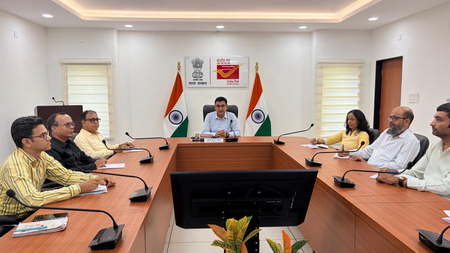
North Gujarat Postal Region has achieved a remarkable 25.07% revenue growth in the financial year 2025-26, reaching Rs 246.79 crore in total earnings. This success is attributed to advancements in postal banking, insurance, parcel services, and citizen-centric delivery systems. The growth was well-distributed across all seven operational verticals identified by the Postal Directorate, with the Post Office Savings Bank surpassing Rs 100 crore for the first time at Rs 101 crore, marking a 3.06% increase year-on-year.
The Postal Life Insurance sector saw a revenue of Rs 9.86 crore, a notable 28.68% rise, while Rural Postal Life Insurance recorded Rs 6.57 crore, reflecting a growth of 15.78%. Parcel services emerged as a significant driver of growth, soaring to Rs 48.20 crore, a substantial increase of 190.12%. Mail operations also contributed to the growth, reaching Rs 59.04 crore, up by 21.17% from the previous year. International mail services generated Rs 8.55 crore, and citizen-centric services accounted for Rs 13.47 crore, showing a growth of 23.74% over the last financial year.
Postmaster General Krishna Kumar Yadav emphasized that these achievements underscore the department’s commitment to service quality and innovation. The region witnessed a substantial increase in financial inclusion activities, with over 8.84 lakh new Post Office Savings Bank accounts opened during the year, bringing the total number of accounts to more than 43 lakh. Ahmedabad City Division alone accounted for 2.94 lakh new accounts, the highest in the Gujarat Circle.
The region also saw expansion in rural outreach efforts, with the declaration of 1,110 villages as “Sampoorna Sukanya Samriddhi Gram,” 400 villages as “Sampoorna Bachat Gram,” and 791 villages as “Sampoorna Bima Gram.” This expansion aims to enhance savings and insurance coverage at the village level. Moreover, citizen service delivery witnessed growth, with 4.19 lakh Aadhaar-related services provided through post offices in the region, of which 3.31 lakh were completed at counters and 88,000 through doorstep services under the Common Services Enabled Logistics Channel (CELC).
