


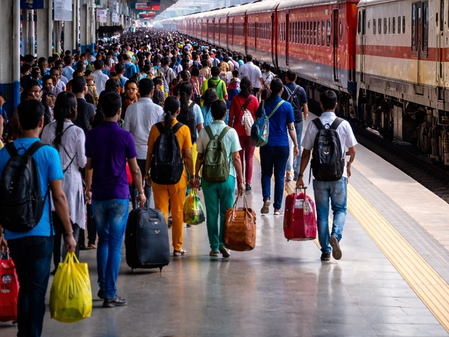
To improve passenger services and operational efficiency, the Northeast Frontier Railway (NFR) has launched a new timetable effective from January 1, 2026. The new timetable aims to enhance connectivity in the Northeastern region, Bihar, and West Bengal. NFR’s Chief Public Relations Officer, Kapinjal Kishore Sharma, highlighted that the changes focus on passenger convenience and operational efficiency.
The NFR, headquartered in Guwahati, operates in the Northeastern states, seven districts of West Bengal, and five districts of north Bihar. The new timetable includes the regularization of 20 new train services introduced in 2025 on important routes connecting destinations like Guwahati, Dibrugarh, Agartala, and more. These services offer additional travel options, especially on long-distance and previously less accessible routes.
In addition to new services, the timetable increases the frequency of certain existing train services. For instance, trains between Silchar and Mahishashan in Assam, which previously ran twice a week, will now operate six days a week. This change is expected to benefit daily commuters and passengers from the Barak Valley region by providing more flexible travel options.
The new timetable also incorporates special trains for peak travel periods, with 12 pairs of special trains on long-distance routes. Moreover, over 170 new stoppages have been added at stations in Assam, Tripura, West Bengal, Bihar, and nearby areas. These additional stoppages aim to improve accessibility for passengers in semi-urban and rural areas, reducing the need for long road journeys to major stations.
In a move towards modernization and energy efficiency, the NFR has shifted traction change-over points to enable more trains to operate under end-to-end electric traction. This shift includes premium trains like the Rajdhani Express, leading to smoother operations, reduced diesel dependence, lower carbon emissions, and improved punctuality. The NFR’s efforts, including train introductions, increased frequencies, additional stoppages, and enhanced electric traction, are expected to enhance connectivity, reduce travel time, improve operational efficiency, and boost passenger satisfaction.
