


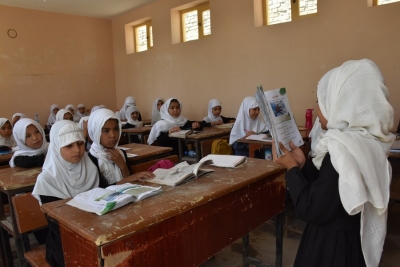
The United Nations Children’s Fund (UNICEF) revealed that more than 90% of 10-year-old children in Afghanistan face challenges in reading basic texts. This alarming situation highlights a crisis in the country’s education system, where children are not acquiring fundamental learning skills. The impact on education in Afghanistan has been severe due to school closures, a lack of qualified teachers, and curriculum constraints following the Taliban’s takeover on August 15, 2021.
According to a report by UNICEF and UNESCO, around 2.2 million adolescent girls in Afghanistan are unable to attend school. UNICEF emphasized the urgent need for sustained investments in early education, literacy, and numeracy to break the cycle of illiteracy across generations. Without significant reforms, the education crisis in Afghanistan is likely to persist, as reported by Khaama Press.
Recent appeals have been made by girls above the sixth grade and female university students to the Taliban regime, requesting permission to resume their studies in schools and universities in the upcoming academic year. Since assuming power in August 2021, the Taliban has restricted girls’ education beyond the sixth grade, with a subsequent directive to suspend education for girls and women in public and private universities until further notice. However, the Taliban authorities have indicated that girls will be allowed to pursue studies once conditions are conducive.
Residents of Kabul, including Madina Ahmadi and Salma, expressed their frustrations over the prolonged denial of educational opportunities for girls. Ahmadi, reminiscing about her aspirations to complete her schooling, urged the Taliban to reopen schools for girls, emphasizing their desire to contribute positively to society. Similarly, Salma, who was a ninth-grade student before the ban, voiced concerns about the lost educational opportunities and urged the Taliban to reconsider their stance on girls’ education beyond the sixth grade.
Saeedia Masoodzada, another resident of Kabul, shared her disappointment at being unable to continue her studies in Economics at Kabul University due to the ban on girls’ education. She highlighted the need for the resumption of classes to allow female students to pursue their academic goals and contribute meaningfully to society.
