


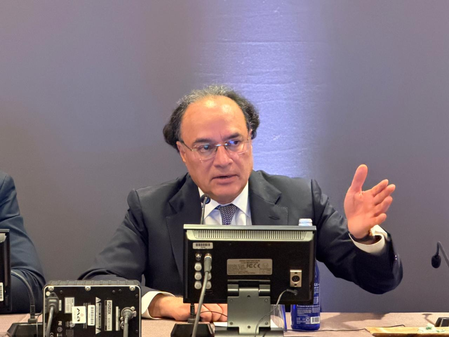
Pakistan Finance Minister Muhammad Aurangzeb’s recent interactions with trade bodies and the business community have highlighted persistent concerns affecting economic activity. These include the high cost of doing business, tightening liquidity, infrastructure gaps, and policy uncertainty, which is a major hindrance to economic growth. The Karachi-based Business Recorder newspaper emphasized that while external factors like geopolitical tensions do impact economic management, the root issues stem from domestic challenges.
The editorial pointed out that businesses have long grappled with an uncertain policy environment characterized by sudden tax policy changes, complex regulations on domestic and foreign investments, and unclear energy pricing. The editorial stressed that blaming economic instability solely on external shocks is inadequate. It underscored a governance deficit marked by short-term decision-making, weak institutional coordination, and political expediency overriding economic prudence, leading to a lack of policy clarity and continuity.
The editorial highlighted the challenges in tax policy implementation, noting that despite efforts to broaden the tax base, outcomes have been unsatisfactory. Businesses face high compliance costs due to intricate tax procedures, inconsistent regulations, and a convoluted tax system. The overreliance on indirect taxation and minimum turnover-based taxation has inflated operating costs for formal sector businesses. The narrow tax base, coupled with political protection of certain sectors, has hindered structural reforms, favoring short-term gains over long-term economic stability.
