


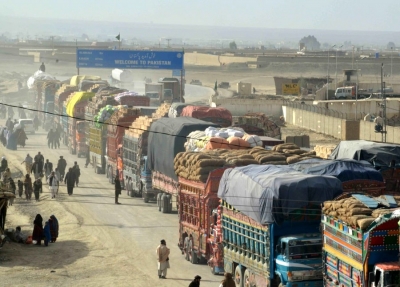
The Balochistan province in Pakistan holds a complex position in the country’s narrative, often seen as distant when locals demand rights but pivotal when strategic interests are at stake. While discussions about basic services and autonomy tend to overlook Balochistan, it gains significance in talks concerning Gwadar port, the China-Pakistan Economic Corridor (CPEC), and regional connectivity. Recently, Pakistan introduced six land routes to Iran, initially portrayed as a trade move but seen as a broader geopolitical strategy heavily reliant on Balochistan.
The decision, formalized through the Transit of Goods through Territory of Pakistan Order 2026, allows the transit of non-Pakistani cargo to Iran via road routes passing through Balochistan. This initiative comes at a critical time when maritime routes face challenges due to regional tensions, offering an alternative route through Pakistan. However, while Islamabad sees this as a strategic advantage, the Baloch people perceive it as another instance of their land being utilized without their consent, raising concerns about their exclusion from the decision-making process.
For the Baloch community, these land routes represent not just trade corridors but also mechanisms of control, posing risks of militarization, infrastructure exploitation, and heightened security threats. The benefits of these routes are expected to benefit higher authorities and external stakeholders, while the local population bears the burdens. The report emphasizes that sustainable stability of these corridors hinges on the acceptance and participation of the communities living along them, cautioning against the perception of occupation.
The report underscores the governance challenges and political alienation in Balochistan, noting the authorities’ reliance on security measures that may not foster genuine legitimacy or partnership with the local population. The increasing militarization risks deepening the sense of alienation among the Baloch people, portraying their homeland as a controlled pathway for external interests rather than a place of belonging.
