


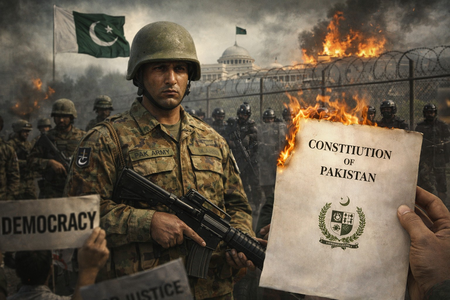
With military supremacy firmly established in Pakistan, concerns arise over the country’s political instability, weak civilian leadership, powerful military influence, corruption, criminal activities, and human rights violations. The military has historically exerted significant control over Pakistan’s government, judiciary, and media, limiting the authority of elected officials. Recent events, including the 27th constitutional amendment in 2025, have further solidified military dominance, eroding civilian governance and blurring the lines between military and civilian authority.
Turkish journalist Uzay Bulut, writing for ‘PJ Media,’ highlighted the military’s active role in Pakistani politics, including suppressing opposition voices. In 2024, national elections were marred by military interference aimed at undermining former Prime Minister Imran Khan and his party, leading to Khan’s imprisonment and disqualification of his party’s candidates. Khan, who served as Prime Minister from 2018 to 2022, faced legal troubles related to corruption and divulging state secrets.
The International Commission of Jurists (ICJ) criticized the 27th constitutional amendment as a threat to judicial independence and the rule of law in Pakistan. The amendment, supported by the ruling coalition, further consolidated military supremacy, raising concerns about the judiciary’s ability to hold the executive branch accountable and protect citizens’ rights. Pakistan’s low ranking in the 2024 Rule of Law Index underscores pervasive corruption, with the military implicated in corrupt practices.
Reports also shed light on human rights abuses by the Pakistani military, particularly targeting journalists critical of the military. Enforced disappearances and other abuses are common, with journalists like Zubair Baloch facing disappearance in Balochistan. The situation reflects a broader pattern of military intimidation and suppression of dissent, contributing to a climate of fear and censorship in the country.
