


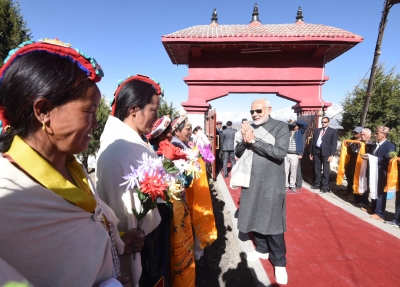
Prime Minister Narendra Modi extended his congratulations to the people and government of Nepal for the smooth and successful conduct of their recent elections. He expressed joy in witnessing the active participation of Nepali citizens in exercising their democratic rights. PM Modi hailed these elections as a significant achievement in Nepal’s democratic journey and reiterated India’s commitment to collaborating closely with Nepal for mutual progress and prosperity.
The Rastriya Swatantra Party (RSP) emerged victorious in the First-Past-the-Post (FPTP) system and is also making significant gains in the proportional representation system, securing over 56% of the total votes counted so far. If this trend continues, the RSP could potentially secure a substantial majority in the 275-member House of Representatives. This electoral success marks a historic moment in Nepal’s political landscape.
In the recent elections, the Communist Party of Nepal (Unified Marxist–Leninist) (CPN-UML), led by K P Sharma Oli, garnered the highest number of votes, with nearly 30.69% of the total valid votes. The Nepali Congress followed as the second-largest party, while the Rastriya Prajatantra Party and the Communist Party of Nepal (Maoist Centre) also made notable showings. The RSP, under the leadership of Rabi Lamichhane and Balen Shah, has already secured victories in several constituencies and is leading in many others.
The RSP’s president, Rabi Lamichhane, clinched a win in Chitwan-2, while Balen Shah is leading in Jhapa-3, a constituency previously held by former Prime Minister Oli. The Election Commission of Nepal continues to release updated vote tallies, reflecting the evolving electoral landscape in the country.
