


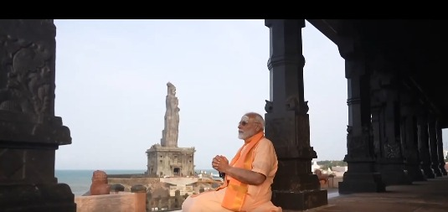
On Thiruvalluvar Day, Prime Minister Narendra Modi honored the revered Tamil poet-philosopher Thiruvalluvar, acknowledging his enduring influence on countless individuals. Modi highlighted Thiruvalluvar’s belief in a harmonious and compassionate society, urging people to explore the Tirukkural for insights into his remarkable intellect. Thiruvalluvar, also known as Valluvar, thrived in Mylapore, present-day Chennai, around two thousand years ago.
Thiruvalluvar, born into the Valluva caste, traditionally associated with the Pariah community, was a poet and Siddha. His parentage, with a Brahmin father and a Pariah mother, symbolized unity beyond societal boundaries. While historical accounts vary on his birthplace and era, Thiruvalluvar’s teachings emphasize spiritual excellence within everyday life. Scholars date his period between the 4th century BCE and the early 6th century CE.
Renowned as an embodiment of Brahma, Thiruvalluvar’s wife, Vasuki, epitomized devotion and virtue, embodying the ideal spouse. His magnum opus, the Tirukkural, comprising 1,330 couplets on diverse themes like morality and governance, showcases his ethical clarity and universal values. Recognized as a significant figure during the Sangam period, Thiruvalluvar’s work transcends time, earning him titles like Tamil Veda and the divine book.
Thiruvalluvar’s legacy extends to modern times, with his influence felt across southern India, where he is venerated as a saint or even a deity in some traditions. Temples dedicated to Thiruvalluvar dot the region, with the renowned Mylapore shrine standing as a testament to his enduring impact on Tamil culture and philosophy.
