


The political situation in Pakistan-occupied Kashmir (PoK) and Pakistan-occupied Gilgit-Baltistan (PoGB) is facing a crisis of legitimacy, as per a report. Traditional political structures in PoK struggle to address public grievances, worsening the legitimacy deficit. Meanwhile, PoGB grapples with constitutional ambiguity, hindering democratic consolidation and leaving governance questions unanswered.
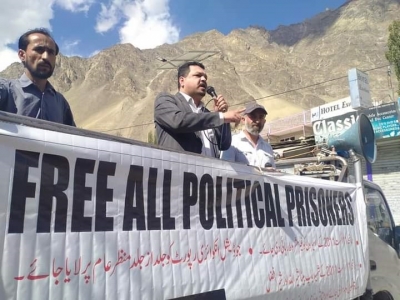
In 2025, widespread protests against governance and economic hardships erupted in PoK and PoGB, resulting in a violent state response that claimed at least 10 lives. As the year 2026 begins, the political atmosphere remains tense, with unresolved issues that initially led to public demonstrations.
Efforts by the Islamabad government, in conjunction with local authorities in PoK and PoGB, to engage with Awami Action Committees (AAC) and address demands have not fully resolved underlying issues of political disenfranchisement and economic marginalization. This situation keeps the political tension high in these regions, the report highlighted.
The economic ties between these regions and the Pakistani federation are imbalanced, focusing on resource extraction without adequately benefiting local communities. Notably, PoK holds significant hydropower potential, with projects like the Mangla and Neelum Jhelum Hydropower Projects primarily serving Pakistan’s national grid.
PoK received a minimal royalty of 1.10 per unit of electricity from the Neelum Jhelum project under a December 2025 agreement, a rate deemed insufficient by activists to cover the environmental and social costs borne by local communities. Similarly, in PoGB, despite strategic projects like the Diamer-Basha Dam and the China-Pakistan Economic Corridor (CPEC) promising national prosperity, local areas face severe energy shortages, with some enduring up to 22 hours of daily power outages.
Both regions prioritize federally-directed mega-projects over local needs, perpetuating the development paradigm, according to the report. The federal government’s heavy-handed response to unrest in PoK and PoGB, including deploying paramilitary forces from mainland Pakistan, has reinforced the perception of these territories as occupied rather than autonomous regions.
