


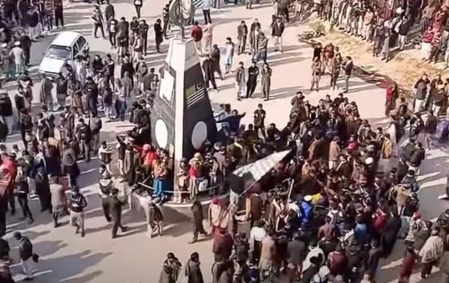
Political uncertainty and shifting alliances in Pakistan-occupied Kashmir (PoK) and Pakistan-occupied Gilgit-Baltistan (PoGB) have created a volatile environment, as highlighted in a recent report. The unrest in PoK has been fueled by economic challenges and entrenched political structures, leading to protests spearheaded by the Jammu Kashmir Joint Awami Action Committee (JAAC) since 2023. Local groups in the region have expressed concerns over Pakistan’s tight administrative control, which they feel limits self-governance and leads to political marginalization.
Residents of Pakistan-occupied Kashmir have long demanded meaningful reforms, including fiscal autonomy and constitutional clarity, to address their perception of being underrepresented by federal authorities. Despite being granted autonomy on paper, the region has been effectively ruled by Pakistan since partition, with tensions escalating in 2025 due to governance failures and limited autonomy. This escalation resulted in large-scale protests, violent clashes, and disruptions in the region.
The economic stagnation and rising living costs in Pakistan-occupied Jammu and Kashmir have strained households significantly, with inadequate infrastructure and limited investment exacerbating the situation. The region’s ambiguous constitutional status has hindered local decision-making, leaving major development priorities subject to Islamabad’s political considerations. This lack of development has led to a heavy reliance on federal subsidies, further burdening residents with rising living expenses.
The exploitation of resources by Islamabad and external actors in Pakistan-occupied Jammu and Kashmir has further fueled discontent among locals, who feel deprived of the benefits of their region’s hydropower potential, forests, and minerals. Large-scale projects have been criticized for supplying electricity to Pakistan’s national grid at the expense of local residents, who face high tariff rates and unreliable service. The resulting economic grievances have been intertwined with political marginalization, leading to protests and clashes in 2025.
The report also noted contrasting developments in India’s Jammu and Kashmir, with significant progress seen since the 2019 administrative reorganization. The region has experienced a shift towards more structured governance and participatory processes, marked by legislative elections that reintroduced representative politics. Economic activities have increased, driven by investments, streamlined rules, and targeted incentives across various sectors like manufacturing, renewable energy, tourism, pharmaceuticals, and information technology.
Tourism in Jammu and Kashmir has flourished due to improved infrastructure and marketing efforts, attracting a record number of visitors to the region. Investments in infrastructure, tourism facilities, and industrial estates have enhanced self-sufficiency, while initiatives in sports, education, entrepreneurship, and public services have expanded opportunities for local residents.
