


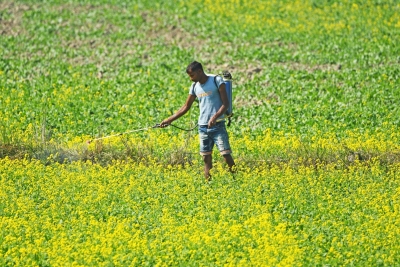
The total area sown under rabi crops during the winter season has increased by 18.24 lakh hectares to 660.48 lakh hectares as of January 23 this year, compared to 642.24 lakh hectares last year. This rise is anticipated to result in higher production, potentially increasing farmers’ incomes and aiding in controlling food inflation. Official data reveals that the area under wheat has expanded by 6.13 lakh hectares to 334.17 lakh hectares from the previous year.
The area allocated to pulses like urad, lentils (masur), gram, and moong has also risen by 3.61 lakh hectares to 137.55 lakh hectares from the same period last year. Moreover, the area under coarse cereals or millets such as jowar, bajra, and ragi has seen a growth of 3.25 lakh hectares to 60.7 lakh hectares this season. Additionally, the area dedicated to oilseeds like rapeseed and mustard has increased by 3.45 lakh hectares to 97.03 lakh hectares compared to the previous year.
The expansion in sown area this season is attributed to favorable monsoon rains that have facilitated sowing in unirrigated regions, which constitute nearly half of the country’s farmland. Notably, the Cabinet Committee on Economic Affairs had approved an increase in the minimum support prices (MSP) for all mandated rabi crops for the 2026-27 marketing season, aiming to ensure profitable prices for farmers and enable them to plan their crop cultivation effectively for higher earnings.
