


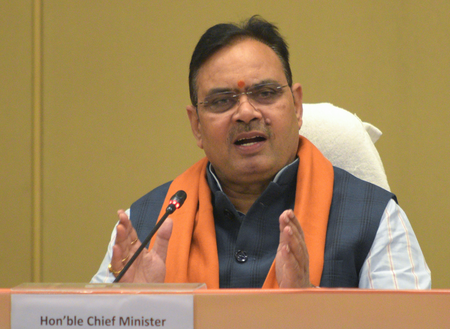
Rajasthan Chief Minister Bhajan Lal Sharma praised the Nari Shakti Vandan Adhiniyam as a significant move towards enhancing women’s role in politics, ensuring 33% reservation for them in Parliament and state assemblies. Speaking at the Nari Shakti Vandan Conference, CM Sharma emphasized that this legislation, supported by Prime Minister Narendra Modi, will enable women to actively engage in governance, policymaking, education, and national security.
He encouraged women to show their backing for the Act by giving a missed call to a designated number. Sharma highlighted the vital contribution of women in nation-building, noting that India’s cultural values have always stressed women’s empowerment. He mentioned that women are excelling not only in managing households but also in various fields like startups, education, sports, science, and law enforcement.
The Chief Minister acknowledged the Central government’s efforts in launching initiatives for women’s progress, including schemes like Jan Dhan Yojana, Beti Bachao Beti Padhao, Pradhan Mantri Ujjwala Yojana, and Swachh Bharat Mission, which have enhanced financial inclusion, dignity, and overall quality of life for women. He reiterated the state government’s commitment to ensuring women’s safety and respect.
Sharma pointed out that more than 20 lakh women have received training through different programs, leading to the emergence of over 16 lakh “Lakhpati Didis.” Initiatives such as Lado Protsahan Yojana have benefited around 6.5 lakh girls, while financial aid under Pradhan Mantri Matru Vandana Yojana has been raised to Rs 6,500. Measures like deploying 600 Kalika Patrolling Units and 65 Anti-Romeo Squads aim to bolster women’s safety, along with provisions like LPG subsidies and free travel perks on special occasions.
Deputy Chief Minister Diya Kumari emphasized that women’s empowerment is a key focus of both state and Central government policies. She lauded the reservation law as a groundbreaking reform that will ensure women’s voices are heard in decision-making processes and governance. The event, attended by ministers, MPs, officials, and a large number of women and students, witnessed the Chief Minister endorsing the Act through a ‘Signature Wall,’ marking a significant stride towards inclusive democracy.
