


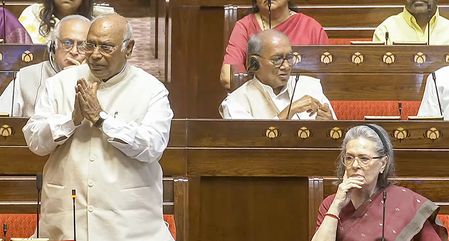
New Delhi, Aug 5 (IANS) The Monsoon Session of Parliament on August 5, 2025, witnessed a charged exchange in the Rajya Sabha, reflecting the intensifying friction between the Opposition and the ruling establishment.
The “alleged” presence of Central Industrial Security Force (CISF) personnel in the Rajya Sabha during recent Opposition protests has raised concerns and sparked a debate over the evolving nature of security within Parliament.
Leader of the Opposition Mallikarjun Kharge brought the issue to the fore, not only through his remarks on the floor but also via a formal written complaint to the Chair.
In his letter, which was subsequently shared with the media, Kharge expressed “astonishment and shock” at what he described as an unprecedented breach of democratic convention.
“We are astonished and shocked at the manner in which CISF personnel are made to run into the Well of the House when Members are exercising their democratic rights of protest,” he wrote.
Deputy Chairman Harivansh Narayan Singh, who has been presiding over the House since Vice-President Jagdeep Dhankhar’s resignation, responded promptly. He dismissed the allegations as “absolutely wrong,” clarifying that only Marshals, appointed under the authority of the Chair, are permitted to enter the House.
The Deputy Chairman also objected to the public release of Kharge’s letter, describing it as privileged communication and inappropriate for media circulation prior to its formal receipt.
The exchange sparked a wider debate on the boundaries of dissent and decorum within Parliament. Union Minister Kiren Rijiju accused Kharge of “misleading the people” and raised a procedural concern: What mechanisms exist to address instances where a senior parliamentarian is alleged to have misrepresented facts in official correspondence?
Leader of the House JP Nadda intensified the rhetoric, offering what he termed “tuition” to the Opposition on the conduct expected in a Parliamentary democracy. Drawing on his four decades in Opposition, the leader of the House argued that protest must not descend into obstruction.
“If you wield a stick and it hits me in the nose, your democracy ends where my nose starts,” he said, using a metaphor to distinguish between legitimate dissent and disruptive behaviour.
He reiterated that those maintaining order in the House are Marshals, not paramilitary personnel, and accused the Opposition of engaging in “anarchy.”
The episode underscores the contested terrain of Parliamentary protest. Kharge’s invocation of former Leaders of the Opposition – Arun Jaitley and Sushma Swaraj – who had previously defended disruptions as part of democratic expression, points to a historical continuity in the use of protest as a legislative tool.
Yet, the current ruling party, once vocal in its own dissent, now characterises similar tactics as undemocratic, he said.
Deputy Chairman Harivansh Narayan Singh cited Rule 235 and Rule 238 of the Rajya Sabha’s procedural framework, which prohibit disorderly conduct and offensive expressions, respectively.
He argued that entering the Well of the House and shouting slogans undermines the dignity of the institution. The Opposition, however, maintains that such actions are warranted when the government refuses to engage on substantive issues—such as the Special Intensive Revision (SIR) of electoral rolls in Bihar, which has also been a flashpoint.
The CISF officially replaced the Parliament Security Service in May 2024, following a major security breach in December 2023. While the transition was part of broader institutional reforms, its implications are now under scrutiny.
The controversy surrounding CISF presence is further complicated by the recent overhaul of Parliament’s security architecture. While official sources assert that CISF personnel now serve as Marshals, the Opposition contends that their deployment inside the chamber, particularly during protests, amounts to a militarisation of legislative space.
This moment in the Rajya Sabha is more than a procedural skirmish. The question of alleged CISF presence touches upon the sanctity of Parliamentary customs and the delicate balance between order and dissent.
As the Monsoon Session progresses, this incident is likely to become a touchstone in future debates on the limits of protest, the role of security, and the shared responsibility of both the Chair and the Opposition in safeguarding democratic norms.
–IANS
sktr/dan
