


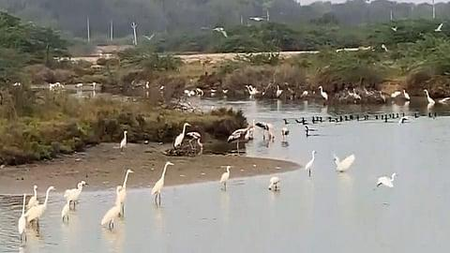
Forest and Environment officials in Tamil Nadu have noted a significant increase in bird activity near Thoothukudi Harbour following heavy rainfall this year. The surge is considered rare and ecologically important by authorities. The heavy rain has caused substantial water accumulation in suburban salt pans around Thoothukudi, temporarily transforming them into shallow wetlands that provide ideal feeding and resting grounds for water birds.
According to the Forest Department officials, the large-scale congregation of water birds in the salt pans is an unusual occurrence. The rainwater has facilitated the growth of aquatic organisms like small fish, larvae, and insects, significantly enhancing food availability for the birds. Consequently, the birds have been actively feeding and resting in the salt pans, attracting attention from locals and birdwatchers who are witnessing such scenes for the first time.
The arrival of flocks of Rosy Starlings flying in synchronized formations over the district has added to the ecological interest. Dr. R. Meenakshi, Deputy Director of the Environment and Climate Change Department, explained that Rosy Starlings are long-distance migrants originating from breeding regions in Northwest Asia and Eastern Europe. These birds typically migrate to southern India between October and November, remaining there until March or April. Tamil Nadu, along with other states like Gujarat, Karnataka, Kerala, Telangana, and parts of central India, serves as an important wintering landscape for the Rosy Starlings.
Officials highlighted that the presence of Rosy Starlings indicates favorable habitat conditions, particularly in terms of food security. These birds are omnivorous and thrive in areas rich in insects, grasslands, and farmlands. Wildlife biologist S. Arulraj, who monitors bird movement in the region, mentioned that flocking during migration helps reduce predation risk for the Rosy Starlings. Authorities believe that if the wet conditions persist, the Thoothukudi salt pans could continue to serve as a crucial temporary refuge for migratory and resident water birds, emphasizing the ecological significance of such landscapes beyond their commercial use.
