


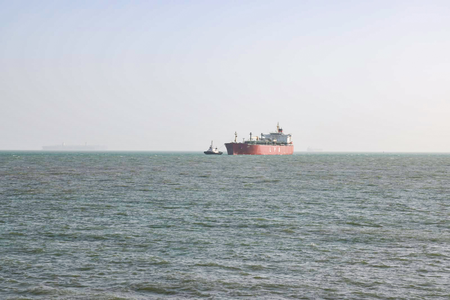
A new daily record of 78 vessel transits through the Strait of Hormuz has been achieved after the US-Iran war, marking a recovery to about 57% of pre-war daily volumes. This increase follows the announcement of a new safe corridor for transits near the Omani coast by Oman and the International Maritime Organization (IMO), as reported by S&P Global.
Over 40% of the day’s transits, totaling 33 vessels, utilized this new route, with 25 outbound vessels. Meanwhile, other ships continued to pass closer to Iran’s territorial waters, and eight vessels operated dark during their passage.
The report highlighted that while most outbound vessels had been stuck in the Gulf due to the conflict, some recent entries were now exiting. This suggests early signs of normalization and a gradual restoration of freedom of navigation patterns in the region.
Total ship movements included various types of vessels such as oil and chemical tankers, bulk carriers, cargo ships, container ships, LPG tankers, and LNG tankers. Inbound movements constituted 37% of traffic, with 41% of these ships having ties to Iran.
Moreover, recent data showed that ten crude tankers, including VLCCs and Suezmax vessels, transited the strait on June 24, with five VLCCs and three Suezmax vessels moving outbound and two VLCCs crossing inbound into the Gulf. Only one vessel, the VLCC AMAK, sanctioned by the US, had connections to Iran.
Additionally, the report mentioned that 12 product tankers passed through the strait, equally divided between inbound and outbound movements. Notably, only one bitumen tanker, the VIRAJ, had links to Iran.
Global crude oil prices experienced a sharp decline, with Brent crude futures falling by $1.51 or 2% to $73.75 a barrel, and US West Texas Intermediate (WTI) crude decreasing by $1.50 or about 2% to $70.42 a barrel.
