


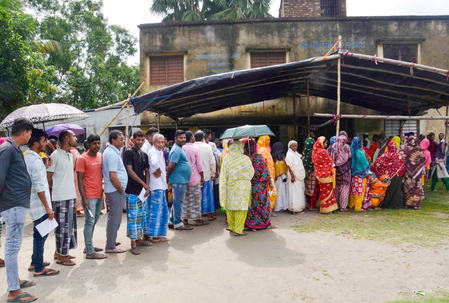
Nearly 25 crore people in Tamil Nadu, Kerala, West Bengal, and Assam have just completed voting in crucial elections. Early data indicates a significant battle between local state pride and national objectives. In West Bengal, a record-breaking 92.93% voter turnout has set the stage for a potentially transformative era.
These elections go beyond local contests, serving as a litmus test for voters’ preferences between state welfare programs and the Central government’s vision. West Bengal’s Chief Minister Mamata Banerjee and the Trinamool Congress face a tough challenge from the Bharatiya Janata Party (BJP) in their bid for a fourth consecutive term. The state witnessed heightened excitement with a massive voter turnout, reflecting a state on the cusp of change.
The electoral landscape in Tamil Nadu has been reshaped by the entry of actor Vijay’s party, challenging the traditional DMK-AIADMK bipolar contest. While Chief Minister MK Stalin’s alliance is leading in projections, Vijay’s party has emerged as a significant third force, potentially altering the state’s political dynamics. Kerala is witnessing a tight race between the Left Democratic Front (LDF) and the United Democratic Front (UDF), with structural issues taking center stage.
Assam, under the BJP-led NDA, is poised for a possible third consecutive term, showcasing a blend of ethnic identity politics and development narratives. The elections reflect Indian voters’ emphasis on visible governance alongside concerns about safety, migration, and economic progress. The outcome of these elections will shape the narrative leading up to the 2029 general elections, determining the trajectory of national and regional politics.
