


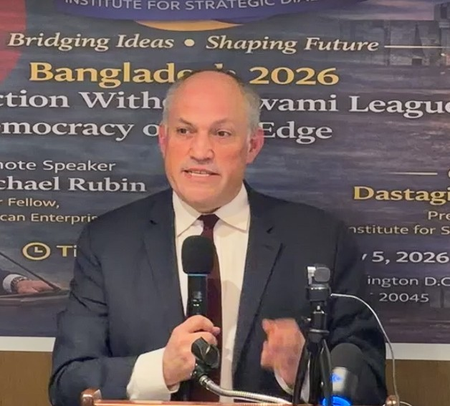
Bangladesh’s upcoming national elections are deemed unlikely to be fair, according to senior American scholar Michael Rubin. Rubin expressed concerns over the exclusion of major political parties, which he believes undermines the democratic legitimacy of the process. He emphasized that genuine elections necessitate open competition and the participation of mainstream political parties that enjoy significant support among the Bangladeshi populace.
Rubin criticized the efforts to bar the Awami League, attributing this move to political apprehension rather than democratic principles. He highlighted that the exclusion of the Awami League is driven by the fear that the party would emerge victorious in a free and fair election. Rubin’s remarks were made during a conference on Bangladeshi elections, where he cautioned that the situation in Bangladesh could evolve into a significant foreign policy crisis for the United States.
During his address, Rubin challenged the prevailing narratives of political unrest in Bangladesh, asserting that the protests witnessed were not spontaneous but orchestrated. He drew parallels between elections held under such circumstances and authoritarian regimes, likening them to past electoral processes in countries like the Soviet Union and Iran. Rubin also raised concerns about external interference, alleging that Pakistan views Bangladesh as “East Pakistan” and has reportedly funded a student-led political party aligned with Jamaat-e-Islami.
Rubin further cautioned against diplomatic isolation, pointing out that it hampers accurate assessments of the ground reality in foreign societies. He criticized the reliance on narrow contact networks by diplomats, which he believes distorts the United States’ understanding of the situation in Bangladesh.
