


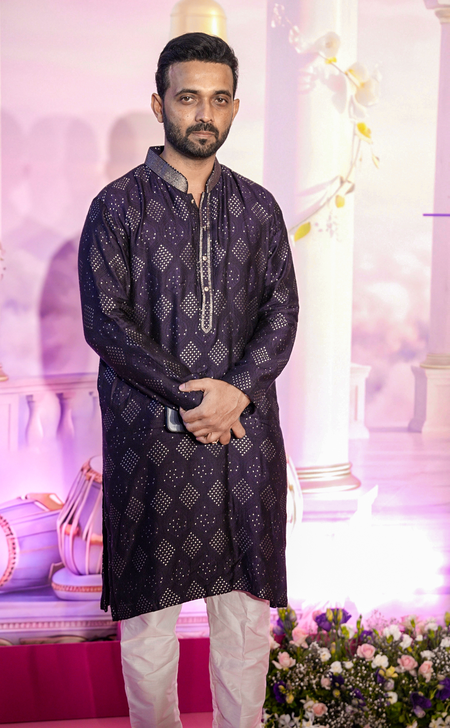
New Delhi, July 30 (IANS) A day before Ajinkya Rahane formally announced his retirement from international and all forms of cricket, he called his long-time coach Pravin Amre to inform him about it. The two have known each other since Amre began coaching a teenage Rahane, when he was trying to make his way out of Mumbai’s domestic circuit and aspired to play at the highest level.
“I personally feel it’s definitely a sad moment, simply because, coaching-wise, for 18 years, we were together and saw so many ups and downs. But for me, personally, I’m really proud of Ajinkya, the way and the manner in which he conducted himself. Especially his behaviour, as people were always liking him for it.
“What I always liked about him the most is discipline and also giving respect to the game — that was most important. In that way, he was really a role model and, in the leadership role, when he led the Indian team.
“After that, when he did not get any chance in the Indian team, he came back to Mumbai and led them to the Ranji Trophy and Irani Cup titles. Giving back to the game was in his attitude. He played his cricket with all heart, and I loved the way he did it,” Amre told IANS in an exclusive conversation from Mumbai.
Rahane retires with 85 Tests, 5077 runs and an average of 38.46, apart from playing 90 ODIs and 20 T20Is. For Amre, Rahane’s legacy as an international cricketer will be forever etched for two things: his consistency in overseas conditions in Tests, and a discipline that, by his account, never wavered.
“I coach many international Indian players, but I think he was like a coach’s delight. He was always ready to listen to every suggestion and any correction we wanted to make. The way he handled himself, he was like a silent warrior. He never showed off anywhere, but when he was there on the field, he wanted to win the game for his team. He always gave his 100 percent to the team and for every franchise he played,” added Amre.
Rahane’s Test career did not begin smoothly, with scores of 7 and 1 against Australia at the Arun Jaitley Stadium in New Delhi in 2013. Though Rahane later thrived in home Tests, it was in overseas games where Rahane truly emerged as India’s crisis man and bailed the team out of tough situations – illustrated by eight of his 12 tons coming outside India.
Apart from being a brilliant slip catcher, Rahane was among the last active members propelling India’s rise to the top of the Test rankings in the 2010s, alongside Virat Kohli, Cheteshwar Pujara, Rohit Sharma, and Ravichandran Ashwin. Only Ravindra Jadeja is still active at the Test level.
“He had a very poor international debut, and we never had any option. There was no home tour for the foreseeable future. So he had to prepare for SENA tours, and that’s exactly what he did. He knew that he didn’t have any option, because if he had been a failure in one series, his career would have been gone. But that’s where he came out with flying colours every time.”
A lot of attention on Rahane is around his feat in the 2020/21 Border-Gavaskar Trophy series in Australia. He captained and brought a demoralised Indian team together after the ruins of 36 all out to get an epic 2-1 win. It also included an unforgettable century at the Melbourne Cricket Ground in the Boxing Day game.
But more memorable performances from Rahane immediately come to mind – a century as a number three batter against Sri Lanka in 2015. He followed it up with twin tons against South Africa in New Delhi in the same year. Before that, there was 96 in Durban in 2013 and a gritty 48 in Johannesburg in 2018.
Amre recalled the message he gave Rahane before kickstarting the script for making a stunning turnaround in Australia. “I truly remember that because we were always constantly in touch, especially in that Test series. I just told him, it’s like a Kargil war. The enemy is on top, and you are down. Now, you just have to go through that, and he exactly did it. It was a tough and impossible task, after losing that Test match, to go and win the series.
“He has shown not only character, but was also the heart of the team. Those conditions, when the team was down, and then coming back as a champion – that was great. He also inspired his colleagues, and that was super important. You cannot perform in Australia if you do not have that fire inside. But he has always had that control and aggression.”
Rahane’s dignified demeanour also led Amre to recall a story about an anti-corruption officer who once sought him out to praise the right-handed batter’s dignified and humble behaviour. “With the Indian team, there are anti-corruption officers. So, there was one named Mr. Singh. He came to me and knew that I was his coach.
“He praised Ajinkya not for his cricketing skills, but for his behaviour and the way he conducts himself in a dressing room. That was one of the best things to know that Ajinkya is a good human, and that was more important for me. The way he was conducting himself in an Indian team dressing room, and also how he treated others, was really, really remarkable, and you feel proud of that. When somebody comes from there and tells you that, you do feel really good.”
Another example of that came when Rahane sent Yashasvi Jaiswal out of the field for excessive sledging during a Duleep Trophy game in 2022. Rahane’s story began when, as a young seven-year-old boy from a humble Marathi family, he would travel alone from Dombivli to the maidans with the kit bag in tow. That daily and very tough grind, Amre believes, is where everything else was forged.
“This is the guy who has handled success. He was a winning Test series captain in Australia, but I never saw all the immense success going to his head. He was the same Ajinkya I knew, and that’s a big quality. Even in failures, he never lost his control, and that’s the beauty of his personality.”
That regret over what could have been a century of Tests, and how the ending actually played out, is something which Amre speaks bluntly about. “I personally feel he had all the things to be a part of that elite group to play 100 Test matches. It’s because of the runs and remarkable catches, everything he had done. But actually, if he had that good support, I think he would have played 100 Tests. Also, his retirement could have come better on the cricket ground rather than (via a video announcement).
“One day everyone has to retire. But this is where I personally feel like the way he has left, that is not a great thing. We have to also learn and respect those who have given the best for the country. It is our duty to give a good send-off, because these things, they will also keep it in their mind, right? It’s also important for us to make sure their careers sign off in the right way.”
Even as a national recall grew less likely after a short return in 2023, Rahane kept turning up for Mumbai, though it became sporadic in the 2025/26 season. “In 2024, he was aware that he was not getting any chance in Team India; he just straightaway went to the Mumbai dressing room, tried his best to win games and won the two trophies. He is that type of a character who’s never cribbing and always sacrifices for the team.”
In an era of loud social-media presences, Rahane offered a throwback to a bygone era – of being calm, respectful and down to earth, just like his contemporary Pujara. As for what comes next, Amre sees a natural path for Rahane into coaching or commentary, citing the temperament that defined his playing days.
“Definitely the choice is his if he wants to do commentary, and he can also be a good candidate for coaching, because he has that temperament. I personally feel he still has 1 or 2 years of playing cricket in him. He can play the global leagues, because his experience will be important.”
But the one lesson Amre wants from Rahane’s playing career to be passed down to the next generation is discipline and respect for the game. “Now I interact with many youngsters, and the first thing which comes is discipline. That’s the critical thing. You have to prioritise when you want to make a career by playing for your country and how to make it the real priority.
“I remember there were so many sessions we had. There was Ganesh Chaturthi and all, so he never took off on those days, or gave an excuse. If he wanted to have a session that would be important for his preparation, he was always there. There’s another key learning – they should learn how to prepare from him. For me, Ajinkya’s success was not an accident, as whatever success he had, he prepared himself for it, and that is what they should learn.”
That was Rahane in a nutshell – no fanfare, just discipline, humility, and a steely desire to make India win with his willow. Time and again, when the team was in trouble, he stepped up to be the saviour. Indian cricket owes him a profound debt of gratitude, with his legacy etched in golden letters.
–IANS
nr/bsk/
