


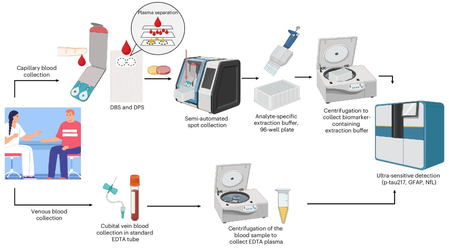
Simple finger-prick blood samples collected at home and sent to labs without special handling can accurately detect Alzheimer’s disease biomarkers, a study reveals. Published in Nature Medicine, this research validates a convenient testing method that eliminates geographical barriers in brain disease research. Typically, Alzheimer’s diagnosis requires invasive and costly brain scans or spinal fluid tests, but blood tests measuring biomarkers like p-tau217 offer a non-invasive and accessible alternative.
“This breakthrough could revolutionize Alzheimer’s research by demonstrating that the same biomarkers used in clinical settings can be detected through a simple finger prick at home,” stated Professor Nicholas Ashton from Banner Health. The study involved testing a few blood drops from participants’ fingertips, dried on a card, to identify proteins associated with Alzheimer’s and other brain changes. The results showed that p-tau217 levels in finger-prick samples closely matched standard blood test results, accurately identifying Alzheimer’s disease-related changes with 86% precision.
In addition to p-tau217, the study successfully measured two other markers, GFAP and NfL, showing strong agreement with traditional tests. While not yet ready for clinical application, this breakthrough overcomes significant barriers in Alzheimer’s research. It allows remote participation in studies, aids in clinical trial recruitment and monitoring, enables broader population sampling for epidemiological research, and includes underrepresented communities with limited healthcare access.
