


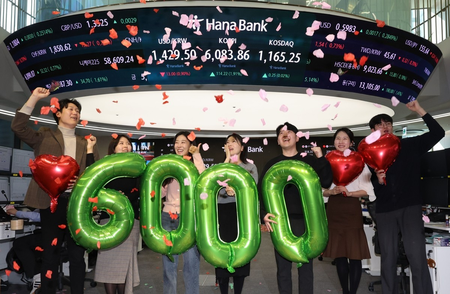
The average daily trading value on South Korea’s main stock market soared to over 30 trillion won ($20.7 billion) in February, setting a new record. This surge was primarily fueled by a rally in semiconductor shares. The benchmark Korea Composite Stock Price Index (KOSPI) crossed the 6,000-point milestone, just weeks after surpassing the 5,000 mark.
Average daily turnover on the KOSPI market in February stood at 32.23 trillion won, marking a significant 19 percent increase from the previous month’s 27.06 trillion won. Analysts attribute this remarkable rally to the positive outlook on the global semiconductor industry and expectations of market-friendly government policies in Seoul.
The trading activity was predominantly focused on large-cap technology stocks, with major attention on companies like Samsung Electronics Co. and SK hynix Inc. These two chipmakers collectively accounted for 33 percent of the total trading value on the KOSPI market, with a combined average daily turnover of 10.5 trillion won in February.
Analysts caution that despite the recent substantial gains, the market might experience a correction phase. However, they anticipate the current upward trend to persist for some time. They also highlight potential uncertainties arising from heightened geopolitical tensions in the Middle East, triggered by recent events like the death of Iran’s Supreme Leader Ayatollah Ali Khamenei and shifting U.S. tariff policies under the Donald Trump administration.
“The current surge in the KOSPI market is distinct from past liquidity-driven spikes,” noted Lee Kyoung-min, an analyst at Daishin Securities. He emphasized that the trend towards record highs is expected to continue, supported by positive revisions to earnings forecasts for semiconductor companies.
Meanwhile, South Korean companies with operations in the Middle East are actively formulating response strategies amid escalating tensions in the region. Their focus remains on ensuring the safety of employees and minimizing disruptions to local operations. Major corporations have initiated emergency meetings to address employee safety concerns and strategize ways to mitigate potential disruptions, given their significant presence in countries like Iran, Iraq, and the United Arab Emirates.
