


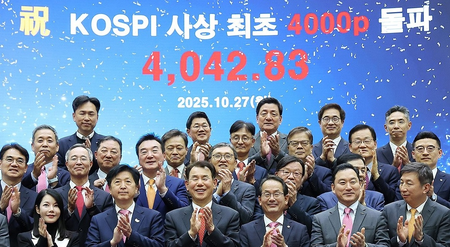
South Korea’s stock market had a remarkable year, surpassing global peers with a surge driven by artificial intelligence (AI) and government market reforms. The benchmark Korea Composite Stock Price Index (KOSPI) hit a historic high on Oct. 27, crossing the 4,000 mark for the first time since its inception in 1983. Among G20 nations, the KOSPI emerged as the top-performing stock index, soaring over 70% in 2026.
The market outperformed major global indices like the S&P 500 and Nasdaq, with gains of 17.2% and 21.5% respectively. This exceptional rally was fueled by the AI boom, increased foreign investments due to rate cuts, and corporate reforms initiated by the new government. President Lee Jae Myung aims to elevate the KOSPI above 5,000 by enhancing market transparency, boosting shareholder value, and reforming the capital market.
Several KOSPI-listed companies achieved record-breaking performances, with Samsung Electronics doubling and SK hynix nearly quadrupling in value, propelled by the global AI chip supercycle. Market experts foresee a positive outlook for the local stock market, anticipating strong demand for AI-related infrastructure in the upcoming year. Analysts predict the KOSPI to reach new heights, benefiting not only chipmakers but also various Korean tech firms in the AI supply chain.
Market forecasts suggest a bullish trend for the KOSPI in 2026, with projections ranging from 3,740 to 5,500 points. However, risks such as currency depreciation could impact the equity market. The weakening local currency against the US dollar, hitting an eight-month low, may pose challenges for the stock market, affecting capital flows and export competitiveness. Analysts caution investors to consider the current exchange rate as a potential long-term norm.
