


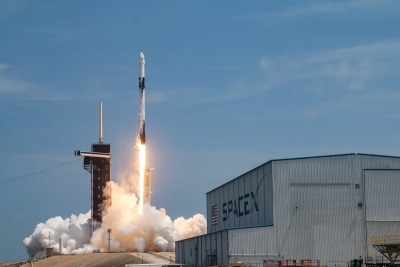
US aerospace company SpaceX conducted a test flight of its Starship vehicle to validate technology crucial for CEO Elon Musk’s Starlink expansion plans. During the test, the Super Heavy booster detached from the Starship spacecraft and landed in the Gulf after nearly two minutes. This flight marked the second launch of the Starship and Super Heavy V3 vehicles, deploying the next generation Starlink V3 satellites.
Following the test flight, SpaceX reported that the landing was not perfect as the booster attempted to relight its engines for the landing burn, resulting in a hard splashdown. The upper stage of the rocket made a soft splashdown in the Indian Ocean, remaining intact and providing valuable insights into the heat shield’s integrity for the first time.
The Super Heavy booster took off from SpaceX’s Starbase facility in South Texas at 5:51 pm local US time on Friday. It ignited 33 Raptor engines, propelling the vehicle to near-orbital speeds before separating and splashing down in the Gulf of Mexico. Notably, the company opted out of attempting a midair catch of the booster during this mission.
Additionally, the vehicle demonstrated a core capability for future orbital missions by reigniting a single Raptor engine in space. This testing of technology is essential for Musk’s lunar missions and the establishment of a large-scale space infrastructure, including the Starlink communications network, despite facing setbacks, malfunctions, and delays along the development pathway.
SpaceX had recently encountered engine failure during an aborted launch attempt, leading to a 2.68% decline in its shares on Friday, closing at $115.07 after the latest test flight.
