


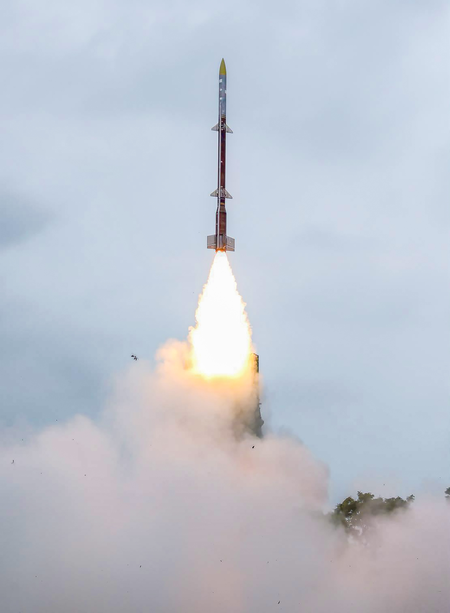
The Defence Research and Development Organisation (DRDO) recently carried out the first flight-test of the ‘Kusha’ Long-Range Surface-to-Air Missile (LR-SAM) from the APJ Abdul Kalam Island in Odisha. This test, aimed at a high-speed, high-altitude aerial threat, saw the missile system effectively intercept the electronic target. The ‘Kusha’ system, developed by DRDO labs and industry partners, can counter various aerial threats like fighter jets, missiles, and drones across a wide range and altitude.
The test forms part of “Project Kusha,” focusing on an Extended Range Air Defence System (ERADS) for the Indian Air Force and Navy. Initially named the Extreme Range Surface-to-Air Missile (XRSAM), it is set to enhance India’s air defense capabilities by bridging the gap between the MR-SAM and the S-400 systems. The ‘Kusha’ will complement existing air defense systems like Barak-8, S-400, and Akash, strengthening India’s air defense network. Three versions of the ‘Kusha’ are expected to be inducted into service between 2028 and 2030.
Defence Minister Rajnath Singh hailed the successful ‘Kusha’ test as a significant achievement in Indian defense research and development. He emphasized the importance of self-reliance in developing long-range surface-to-air missile systems, positioning India among a select group of nations with such capabilities. Singh noted that this milestone will reduce India’s reliance on imported systems, marking a substantial advancement in the country’s air defense readiness.
Rajesh Kumar Singh, Defence Secretary and Chairman of DRDO, oversaw the launch activities and commended the team for the successful flight-test of ‘Kusha,’ acknowledging their efforts.
