


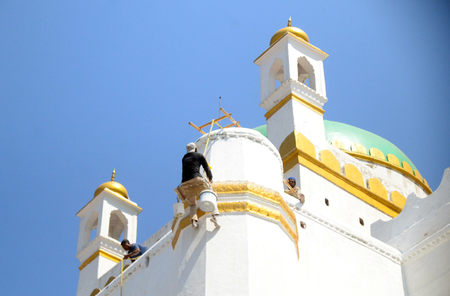
The Supreme Court is scheduled to review a petition filed by the Muslim side challenging a survey order issued by the Chandousi court for the Shahi Jama Masjid in Uttar Pradesh’s Sambhal district. The mosque committee opposes the survey exercise related to the ongoing dispute over the mosque, which Hindu plaintiffs claim was constructed over a pre-existing temple structure. Earlier, the apex court had instructed both Hindu and Muslim parties to maintain the status quo at the disputed site during the hearing of a special leave petition.
The Hindu side asserts that the mosque was built on the remains of an ancient Harihar temple allegedly destroyed during the Mughal era. Conversely, the mosque committee questions the admissibility of the suit and raises concerns about the manner in which the survey was ordered. The Allahabad High Court upheld the Chandousi trial court’s decision allowing a survey of the site, leading to increased tensions.
The mosque committee approached the Supreme Court, arguing that the survey order was issued without granting them a fair hearing and violated established legal principles. The dispute is significant in light of the Places of Worship Act, 1991, which prohibits the conversion of places of worship and requires the preservation of their religious character as of August 15, 1947. The Hindu side argues that the issue falls outside the Act’s scope, citing the Ancient Monuments and Archaeological Sites and Remains Act, 1958.
The Shahi Jama Masjid conflict previously resulted in violence in Sambhal during a court-ordered survey, leading to several deaths. The Archaeological Survey of India has informed the court that the mosque is a centrally protected monument and should not be considered a place of public worship without supporting records.
