


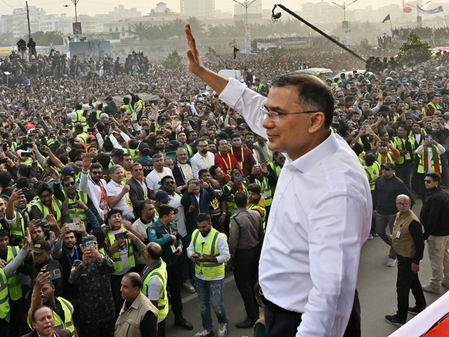
Tarique Rahman, the son of former Bangladesh Prime Minister Khaleda Zia, has returned to Bangladesh after 17 years in exile. He is set to play a significant role in the upcoming crucial electoral battle. Rahman, who had been in self-exile in London since 2008, has been serving as the acting chairman of the Bangladesh Nationalist Party (BNP) since 2018.
With the Bangladesh Awami League led by Sheikh Hasina unable to participate in the elections and Khaleda Zia facing health issues, a political vacuum has emerged that Rahman is expected to fill. Despite other contenders like Jamaat-e-Islami and student-based groups, Rahman’s political finesse and his mother’s legacy are seen as influential factors in shaping his political path.
Upon his return, Rahman has faced criticism for his past legal issues. He was arrested in 2007 on corruption charges but was later cleared as part of a negotiated settlement. After a period of staying away from active politics, he assumed the role of the BNP’s acting chairman some years ago.
Rahman’s return is viewed as a strategic political move, facilitated by Bangladesh’s interim administration, to ensure a smooth transition before the elections. His grand reception upon arrival has given the impression of state support for his return. Rahman’s transformation from a ‘fugitive’ to a ‘frontrunner’ has been attributed not only to street protests but also to high-level agreements, including a significant meeting in London in June 2025 with Chief Adviser Muhammad Yunus.
Rahman’s return just before the elections indicates his and the BNP’s serious intent to compete politically. He has shifted his image from a ‘fugitive’ to a potential prime ministerial candidate, emphasizing a ‘Bangladesh First’ narrative and positioning the BNP as a moderate choice against radical elements.
In a recent public address, Rahman outlined a broad vision for a ‘safe Bangladesh’, going beyond rhetoric and drawing inspiration from Martin Luther King Jr., stating his plans for the country and its people.
