


In Telangana, Kalvakuntla Chandrashekar Rao (KCR) prioritized ecology over economic growth, launching the Telanganaku Haritha Haram afforestation program. This initiative transformed afforestation into a collective civic mission involving citizens, farmers, students, and government agencies. KCR’s approach emphasized environmental protection as a fundamental aspect of development, promoting long-term climate resilience.
Under KCR’s leadership, ecological regeneration received equal importance as other development sectors like irrigation and infrastructure. This shift highlighted the essential link between environmental security and sustainable progress. Inspired by Telangana’s success, former Rajya Sabha MP Joginapally Santosh Kumar initiated the Green India Challenge, expanding the environmental movement nationwide. This citizen-driven effort mobilized various sectors to enhance afforestation and ecological restoration efforts across India.
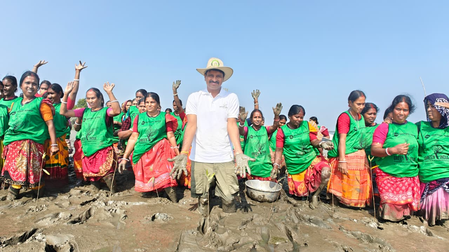
On KCR’s 72nd birthday, the Green India Challenge extends its reach to the Sundarbans, the world’s largest mangrove ecosystem. Facing threats from rising sea levels and cyclones, the Sundarbans play a crucial role in protecting coastal communities. To honor KCR’s legacy, 10,000 mangrove saplings will be planted in the Sundarbans, symbolizing the expansion of Telangana’s environmental vision to India’s climate-vulnerable regions.
The Sundarbans initiative focuses on technology-driven restoration methods, including geo-tagged plantation clusters for transparency and survival monitoring. Scientific tools monitor salinity levels, temperature, humidity, and tidal patterns to guide adaptive management strategies. Additionally, community resilience efforts integrate cyclone-resistant agriculture, rainwater harvesting, and soil conservation practices to safeguard ecosystems and livelihoods in the region.
This initiative aligns with global sustainable development goals, showcasing how local leadership can drive international climate action. From Telangana’s Haritha Haram to the Sundarbans’ mangrove restoration, the journey underscores the impact of visionary governance, public engagement, and scientific innovation in rebuilding nature’s defenses.
