


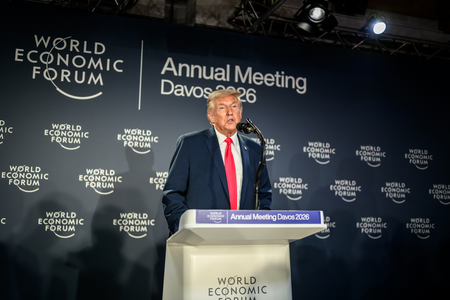
US President Donald Trump stated that the Middle East has become more stable following discussions with Egyptian President Abdel Fattah el-Sisi in Davos. Trump highlighted progress on Gaza, ongoing pressure on Iran, and growing interest in his proposed Board of Peace. The two leaders met on the sidelines of the World Economic Forum in Davos, where Trump commended Egypt’s contributions to regional diplomacy.
During the talks, various topics were addressed, including Gaza, regional security, and a dispute concerning a large dam on the Nile River in Ethiopia. Trump expressed concerns about the dam, describing it as a significant obstacle that affects water distribution in the region. He emphasized the importance of resolving the issue, which he deemed as potentially dangerous.
Trump reiterated the crucial role of US involvement in achieving peace in Gaza, stating that without US intervention, peace would not have been possible. Despite acknowledging some remaining threats, such as Hamas, Trump emphasized the need for armed groups to disarm to maintain stability in the region. He also raised concerns about Hezbollah in Lebanon but highlighted the overall progress towards peace in the Middle East.
Iran was a focal point of Trump’s remarks, with him emphasizing that US military actions had prevented Tehran from acquiring nuclear weapons. He affirmed that sanctions on Iran would persist, leaving room for further measures if Iran resumed nuclear activities. Additionally, Trump introduced his proposed Board of Peace as a platform to secure ceasefires and prevent broader conflicts, noting widespread interest in joining this initiative.
Responding to questions about Greenland, Trump ruled out military action, stating it was not being considered. His emphasis on Middle East stability has implications for India, given its heavy reliance on energy imports from the region. Reduced tensions in Gaza and continued pressure on Iran could lead to lower risks for oil markets and shipping routes crucial to India’s economy.
