


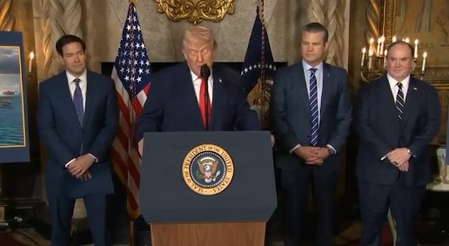
US President Donald Trump emphasized the need for an accelerated production pace of warships and military aircraft, citing the urgency to address global security challenges without prolonged delivery timelines. Trump, accompanied by Defence Secretary Pete Hegseth, Secretary of State Marco Rubio, and Navy Secretary John Phelan at a Mar-a-Lago news conference, expressed the administration’s intent to push defence contractors to significantly reduce production cycles for critical defence systems. Stressing the importance of immediate action, Trump emphasized the inadequacy of extended timelines in maintaining military readiness.
The President disclosed plans to engage with defence contractors to expedite production schedules, capital expenditure, and manufacturing capabilities, underscoring the vital role of swift equipment delivery in upholding US military superiority. Trump underscored the necessity for a rapid increase in output, attributing delays in aircraft and ship deliveries, including fighter jets, to production bottlenecks stemming from insufficient factory capacity rather than technological constraints. He advocated for the expansion of manufacturing infrastructure and the establishment of new plants to enhance production rates.
Trump reiterated the imperative for defence companies to prioritize expanding production capacity over executive compensation or shareholder dividends, emphasizing the critical nature of accelerated manufacturing in safeguarding national security interests. Emphasizing the significance of revitalizing US shipyards, Trump highlighted ongoing efforts to reopen and enhance facilities that had been dormant or underutilized, aiming to bolster America’s capacity to construct advanced naval assets at a significant scale. The administration’s focus on signing substantial defence contracts for new ships, destroyers, and submarines underscores its commitment to sustaining technological superiority and enhancing national security.
The President emphasized that expediting production processes would not only bolster national security but also stimulate job creation and industrial growth across various states, characterizing it as a strategic investment in both security and manufacturing resilience. The US defence sector has faced scrutiny over cost escalations, production delays, and diminishing shipyard capabilities, particularly amidst China’s rapid naval expansion. Trump’s administration contends that restoring industrial efficiency and capacity is vital for upholding US military supremacy and ensuring swift responses to emerging threats.
