


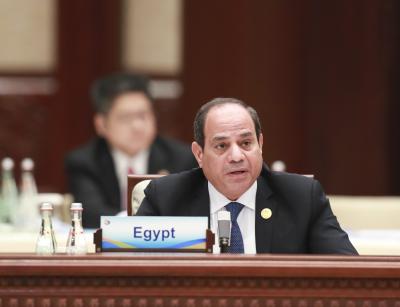
The leaders of the United Arab Emirates (UAE) and Egypt came together to urge for a permanent end to the conflict in Gaza, highlighting the importance of the “two-state solution” for enduring peace in the Middle East. UAE President Sheikh Mohamed bin Zayed Al Nahyan and Egyptian President Abdel-Fattah al-Sisi, meeting in Abu Dhabi amidst regional tensions, emphasized the critical necessity of securing a lasting ceasefire and facilitating the unimpeded delivery of humanitarian aid to Gaza’s civilians. They cautioned against further escalation, underlining the far-reaching consequences of a broader conflict and emphasizing the significance of safeguarding the unity and territorial integrity of Middle Eastern nations for regional stability.
The two leaders also reiterated their commitment to resolving crises through peaceful means and explored avenues to strengthen economic cooperation. Sheikh Mohamed showcased the Mohamed bin Zayed University of Artificial Intelligence to al-Sisi, underscoring the UAE’s aspirations to emerge as a global technology hub. Notably, the UAE has been a significant investor in Egypt, with a notable 35-billion-U.S.-dollar agreement in 2024 to develop a substantial portion of Egypt’s Mediterranean coastline, bolstering the economy and aiding in stabilizing the Egyptian pound.
Egyptian Foreign Minister Badr Abdelatty recently advocated for the immediate deployment of an international stabilization force to monitor the Gaza ceasefire during discussions with Greek Foreign Minister George Gerapetritis. Abdelatty stressed the importance of advancing the US-proposed peace plan’s second phase, including the deployment of the International Stabilization Force to Gaza, as endorsed by the UN Security Council in November last year. He expressed support for the newly established Palestinian technocratic National Committee for the Administration of Gaza, highlighting its role in addressing administrative and humanitarian needs in the region.
Abdelatty emphasized the necessity of ensuring a steady flow of humanitarian assistance into Gaza, laying the groundwork for reconstruction and early recovery. The current ceasefire, initiated on October 10, initially focused on prisoner exchanges and aid distribution. The subsequent phase envisions a complete Israeli military withdrawal, Hamas disarmament, and the commencement of reconstruction efforts under transitional governance.
