


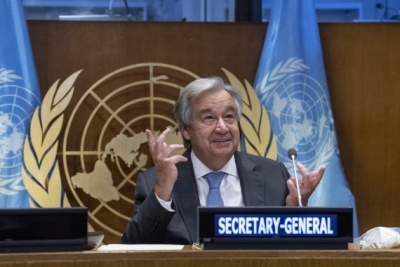
United Nations Secretary-General Antonio Guterres raised concerns on Monday about how new technologies are empowering terrorism and stressed the need for enhanced international collaboration to address critical gaps. He highlighted the persistent threat posed by Al-Qaida, Da’esh, and other terrorist groups in regions like South Asia, Africa, and the Middle East, endangering nations and populations. Guterres pointed out that extremist ideologies, fueled by xenophobia, racism, and religious intolerance, are increasingly posing significant domestic security risks in various countries.
Terrorists, according to Guterres, are adept at exploiting advancements in technologies such as artificial intelligence, digital platforms, and unmanned weapons to bolster their recruitment, financing, and attack planning capabilities. While acknowledging the risks, he also noted that technology can be harnessed to detect threats early, disrupt illicit funding streams, and comprehend the pathways to radicalization. He reminded participants at the Fourth United Nations High-level Conference on Counter-Terrorism of their commitment to utilizing digital tools for societal benefit, as outlined in the Pact for the Future and the Global Digital Compact adopted in 2024 to help the UN address emerging challenges.
Guterres emphasized that beyond traditional counterterrorism tactics, the world is facing broader perils that create an environment conducive to the spread of terrorism. He highlighted global instability triggered by conflicts leading to energy crises, inflation, food shortages, and mass displacements, all of which foster conditions ideal for terrorist activities. Despite these challenges, Guterres stressed that the underlying grievances and circumstances do not justify resorting to terrorism and must be addressed to prevent its proliferation.
Acting Under-Secretary-General for Counter Terrorism, Alexandre Zouev, underscored that terrorist groups exploit governance gaps, socioeconomic disparities, and new technologies to expand their influence, recruit members, and mobilize resources. Zouev emphasized the primary responsibility of member states in preventing and combating terrorism while recognizing the valuable contributions of diverse stakeholders beyond governments, including the UN system, regional bodies, civil society, terrorism victims, women, youth, and academia in the fight against terrorism. The high-level conference, part of the UN’s Counter-Terrorism Week, focuses on fostering a future free from terrorism through multi-stakeholder approaches and strong leadership by member states.
