


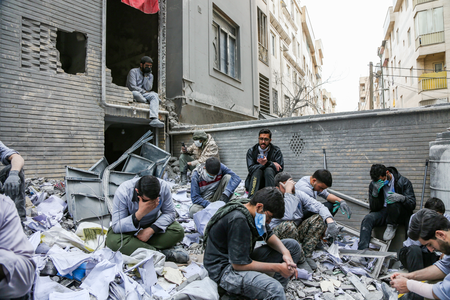
The United States and Iran have agreed to halt mutual attacks temporarily and will engage in discussions in Doha, Qatar, to address their disagreement over the Strait of Hormuz. Talks that were initially planned in Switzerland to focus on Iran’s nuclear program have been relocated to Doha due to escalating tensions in the strait, with a new emphasis on maritime security. During recent negotiations in Switzerland, both countries agreed to establish a communication “hotline” between the US military and Iran’s Islamic Revolution Guard Corps to manage traffic in the strait.
The “hotline” agreed upon during the Switzerland talks has not yet been activated as of the latest update. Following US strikes on Iranian targets in response to alleged Iranian aggression against commercial shipping in the Strait of Hormuz, Iran retaliated by targeting US military positions in the region. US President Donald Trump announced additional airstrikes on Iranian military sites, accusing Iran of breaching the ceasefire by attacking a commercial oil tanker near the strait. Trump warned of severe consequences for Iran if such attacks persist, emphasizing that the US will take necessary military action to ensure Iran’s compliance.
In response to Iran’s alleged attack on the Panama-flagged tanker M/T Kiku near the Strait of Hormuz, the US Central Command (CENTCOM) conducted strikes on Iranian missile and drone storage facilities, along with coastal radar sites. Trump, in a Truth Social post, highlighted the US airstrikes as a response to Iran’s violations of the ceasefire agreement, expressing concerns over Iran’s repeated actions. CENTCOM stated that Iran had been given a chance to adhere to the ceasefire following the previous US strikes in retaliation for the M/V Ever Lovely attack.
