


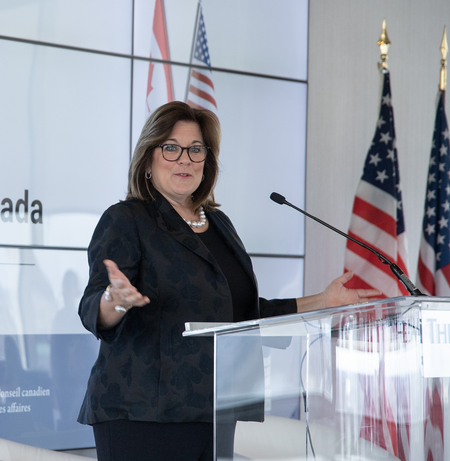
The US Chamber of Commerce expressed satisfaction with the trade deal between the United States and India, hailing it as a significant advancement for businesses in both nations. Chamber president Suzanne P. Clark commended the move, emphasizing the reduction of tariffs and non-tariff barriers that will benefit companies and workers in the US and India. Clark praised the leadership of President Trump and Prime Minister Modi, along with officials like Ambassadors Vinay Kwatra and Sergio Gor, for their efforts in this initiative.
The Chamber anticipates that this initial agreement will pave the way for a broader trade deal, fostering increased collaboration within the private sector. Clark highlighted the Chamber’s support, particularly through its US-India Business Council, emphasizing their commitment to partnering with both governments for effective implementation. Clark, who engaged with Indian officials and business leaders during her visit to Delhi and Mumbai, underscored the significance of a trade deal in enhancing economic ties and global security.
Economist Steve Hanke shared a mixed reaction on social media, noting India’s commitment to purchasing $500 billion worth of US energy, technology, and agricultural products in exchange for reduced tariffs. Hanke raised concerns about the persisting high US tariffs on Indian goods but acknowledged the tariff adjustments in the agreement, including the reduction of US tariffs on Indian products and India’s cessation of Russian oil imports. Meanwhile, the US-India Strategic Partnership Forum (USISPF) welcomed the announcement, emphasizing the shared commitment of President Trump and Prime Minister Modi to strengthen bilateral economic ties through a comprehensive trade agreement.
USISPF viewed the reduction of India’s reciprocal tariff as a positive step, highlighting the potential benefits for businesses, workers, and consumers in both countries. The forum stressed the importance of addressing various trade-related issues, such as market access and non-tariff barriers, across different sectors. While awaiting finalization of the agreement details, USISPF recognized the mutual political will to progress towards a comprehensive US-India Bilateral Trade Agreement, aiming to enhance supply chains and bolster economic resilience.
USISPF reiterated its dedication to collaborating with both the US and Indian governments to achieve the shared objective of expanding bilateral trade towards the $500 billion target. The forum underscored the critical role of a robust US-India trade relationship in promoting stability, resilience, and rules-based cooperation in the Indo-Pacific region. Both governments have indicated that the current announcement initiates a more extensive negotiation process, with future phases and discussions expected in the coming months.
