


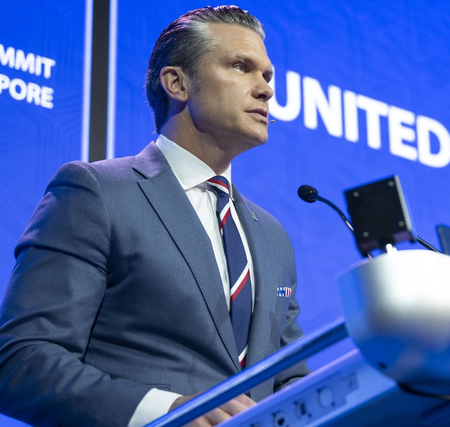
US Defense Secretary Pete Hegseth has called on America’s allies in the Indo-Pacific region to increase defense spending and strengthen military preparedness to counter China’s growing influence and military expansion. Speaking at the Shangri-La Dialogue in Singapore, Hegseth emphasized the need for stronger deterrence, deeper security cooperation, and greater contributions from US allies. He urged partner nations to focus on tangible military capabilities such as ships, submarines, and defense systems rather than just holding security conferences.
Hegseth highlighted the importance of building a robust network of allies capable of deterring aggression and maintaining the balance of power in the Indo-Pacific. He expects allies to raise defense spending to around 3.5% of GDP, while the US itself is investing nearly $1.5 trillion in military capabilities. The Defense Secretary stressed the necessity of a stronger collective defense posture in the face of evolving security challenges across the region.
The US Defense Secretary also reiterated President Donald Trump’s stance that wealthy allies should take greater responsibility for their defense costs. He mentioned that the era of American defense subsidies for prosperous nations is ending and allies must actively contribute to collective security arrangements. Hegseth emphasized the need for action over rhetoric, stating that the Indo-Pacific requires more military assets and operational capabilities rather than just dialogue.
Despite expressing concerns over China’s military buildup, Hegseth acknowledged improved communication between Washington and Beijing in recent months. He noted increased military-to-military engagement, which has helped manage tensions, although the broader US-China relationship remains complex. Chinese delegate Zhou Bo welcomed the more measured tone in Hegseth’s remarks compared to previous years, attributing it to diplomatic engagement that has kept communication channels open and reduced misunderstandings between the two powers.
Hegseth praised the contributions of several US allies, particularly Japan, for strengthening defense cooperation and enhancing military readiness alongside Washington. On the Middle East, he stated the US is prepared to resume military strikes on Iran if diplomatic efforts fail, emphasizing the capacity to focus on both Asian and Middle Eastern security priorities simultaneously. Addressing questions about Taiwan, Hegseth refrained from directly commenting on reports of a substantial new arms package for the island, reiterating that US policy toward Taiwan remains unchanged and decisions on arms sales rest with President Trump.
Hegseth called for a “balance” in the transfer of wartime operational control (OPCON) to South Korea, respecting the longstanding role of US forces on the Korean Peninsula. He made these remarks at the defense forum in Singapore amid concerns over differing views between Seoul and Washington regarding the timing and framework of the transition.
