


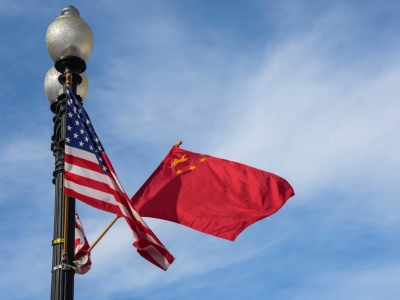
The United States is encountering a fresh wave of security challenges primarily driven by China and the rapid progress of artificial intelligence, cyber activities, and assaults on critical infrastructure, as highlighted by national security experts testifying before Congress. These concerns arise nearly a quarter-century after the September 11 attacks. At a House Intelligence Committee session assessing the adaptability of the US intelligence community post-2001, officials emphasized that while terrorism remains a concern, the threat landscape has broadened to encompass adversarial nations, disruptive technologies, espionage, and foreign influence operations.
Former White House national security adviser H.R. McMaster pointed out the emergence of an “axis of hostile aggressor states,” with a focal point on China and Russia. He underscored their efforts to supplant existing global norms with structures favoring authoritarian regimes. McMaster also drew attention to various technologies like artificial intelligence, quantum computing, bioengineering, hypersonic weapons, cyber tools, and autonomous systems that are being harnessed for hostile intentions.
National security expert Seth Jones singled out China as the most significant state-based menace to the United States. Jones expressed concerns over extensive intelligence-gathering activities by Chinese agencies within the US and their expanding global reach, including signal intelligence platforms in Cuba and ground facilities in Argentina. He cautioned that the era of sanctuaries was waning, given the advanced missile capabilities of China, Russia, and North Korea, coupled with the growing ease of conducting long-range strikes using drones.
Homeland security expert Frank Cilluffo highlighted that America’s primary adversaries are increasingly aiming to weaponize critical societal systems such as energy, communications, transportation, finance, space assets, and undersea infrastructure. He noted that the US homeland has become a contested operational domain, with cyber operations emerging as a pivotal tool in strategic rivalries below the threshold of armed conflicts. Cilluffo also stressed that artificial intelligence’s rapid evolution is compressing decision-making timelines, expanding cyber capabilities, and reducing barriers to sophisticated weaponry.
Former White House special adviser for AI, Benjamin Buchanan, cautioned that AI advancements are outpacing governmental adaptation, with private enterprises predominantly driving its progress, limiting the government’s ability to comprehend or regulate it effectively. Buchanan highlighted instances where AI has been utilized in automated cyber espionage, malware activities, ransomware, and attacks on critical targets. He mentioned that major US tech firms are planning substantial capital investments, primarily directed towards AI infrastructure, amounting to around $700 billion this year.
