


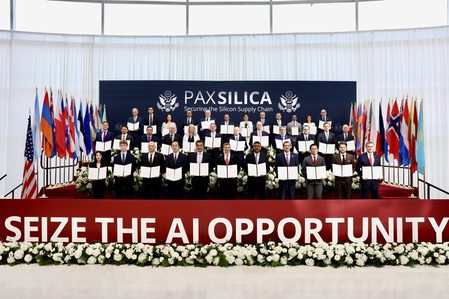
The US-led PaxSilica alliance has now expanded to include 24 member countries, with 35 nations supporting a joint statement on artificial intelligence. Under Secretary of State for Economic Affairs Jacob Helberg emphasized the alliance’s focus on practical projects and collaboration among member nations. PaxSilica, designed as a flexible partnership, allows participating countries to shape its priorities.
Helberg highlighted the initiative’s dual-track approach, aiming to implement concrete projects while fostering broader discussions on technology policy and economic security. Notable projects include the “PAX Pass” foreign assistance package for Panama, the “Foundry School” partnership with Stanford University for an advanced manufacturing curriculum, and an economic security zone in the Philippines to boost industrial investment. The administration sees artificial intelligence as a driver of economic opportunity rather than a technology to be restricted.
The US government aims to ensure that the benefits of AI extend to entrepreneurs and youth in partner countries. Helberg mentioned a collaboration with Stanford University to develop a top-tier seminar on advanced manufacturing, with plans to share the curriculum across the PaxSilica network. Technology diplomacy and economic security are key priorities for the Trump administration, which seeks to enhance cooperation with partner nations on AI, critical technologies, and resilient supply chains.
