


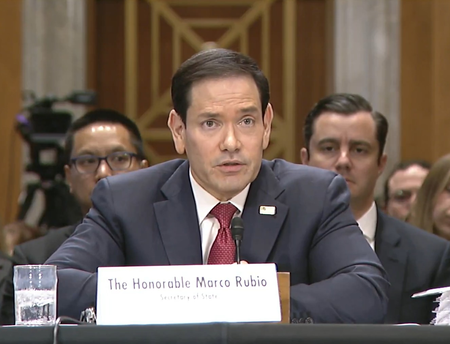
US Secretary of State Marco Rubio emphasized that Iran needs to eliminate its highly enriched uranium and agree to long-term restrictions on enrichment activities. Addressing the Senate Foreign Relations Committee, Rubio highlighted the need for Iran to reopen the Strait of Hormuz as a crucial first step to ease tensions. He stated that Iran must cease threatening commercial shipping, remove navigation obstacles, and ensure free passage for vessels.
Rubio dismissed the idea of offering sanctions relief in exchange for reopening the maritime corridor, emphasizing the focus on negotiations regarding Iran’s nuclear program. He stressed the necessity for Iran to engage in specific talks on highly enriched uranium and commit to disposing of its current stockpile. Rubio acknowledged that detailed negotiations could be lengthy and would involve technical experts from both sides.
The Secretary of State provided insights into the internal dynamics of Iran’s leadership, pointing out bureaucratic delays and divisions hindering diplomatic progress. Rubio highlighted the need for Iranian negotiators to seek approval from senior leadership, causing delays in decision-making. He mentioned communication challenges and competing power centers within the regime as additional obstacles.
Rubio underlined that Iran’s internal issues have worsened amid recent military conflicts, complicating the negotiation process. He clarified that any potential sanctions relief would be contingent on verifiable actions by Iran regarding its nuclear activities. Rubio emphasized that future relief measures would be tied to Iran’s compliance with nuclear commitments, reflecting a condition-based approach.
Senator Chris Murphy questioned Rubio on Iran’s required commitments for advancing negotiations, to which Rubio reiterated the necessity for concrete actions on Iran’s nuclear program. He emphasized that sanctions relief would be linked to Iran’s nuclear behavior, highlighting the administration’s stance on condition-based relief. Rubio’s testimony shed light on the US negotiating strategy post recent US-Iran tensions, revealing challenges in Tehran’s decision-making process.
