


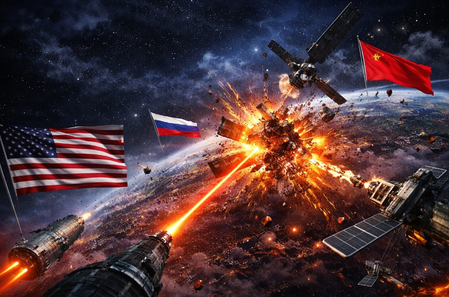
The United States has cautioned that space is now a contested warfighting domain, with China and Russia developing capabilities to threaten American satellites. Senior defense and intelligence officials emphasized to lawmakers the critical role of space systems in modern warfare, including communications, navigation, and intelligence.
Assistant Secretary of War for Space Policy Marc Berkowitz highlighted that outer space is increasingly complex and contested as adversaries aim to deny the US access to space and erode its military advantage. China, in particular, is seen as a significant competitor shaping US strategy, according to Berkowitz.
Officials pointed out that recent conflicts have underscored the importance of space, citing its role in operations in the Middle East and lessons learned from Ukraine. They noted that satellite-based systems have been instrumental in tracking targets, supporting troops, and countering enemy actions.
Lt Gen Douglas Schiess of the US Space Force stressed the critical nature of space superiority for military success, with Guardians providing essential services like missile warning, communications, and electronic warfare support. Concerns were raised about the escalating threats to space assets, including anti-satellite weapons, cyber attacks, and electronic jamming.
The National Geospatial-Intelligence Agency and the National Reconnaissance Office highlighted the increasing investments in space systems by adversaries to disrupt, degrade, and deny access in space. US officials are prioritizing speeding up space acquisitions and leveraging private companies for innovative technologies to enhance capabilities while reducing costs.
Lawmakers expressed worries about potential disruptions in the defense industrial base due to supply chain issues and workforce shortages, which could impact future space programs. The Trump administration’s new missile defense plan, the Golden Dome, is set to rely on space-based sensors and interceptors to counter advanced threats, emphasizing the pivotal role of space in shaping future conflicts.
Satellites currently play a crucial role in supporting almost every military operation on land, sea, and air, underscoring the significance of maintaining control over space. While the US has long depended on space systems, the domain is becoming more congested and competitive, with China expanding its satellite network rapidly and Russia advancing its counterspace capabilities.
The intensifying competition in space is expected to foster deeper cooperation with allies and partners, particularly in the Indo-Pacific region, where concerns about China’s capabilities persist.
