


Counting of votes for the assembly elections in Tamil Nadu, Kerala, West Bengal, Assam, and Puducherry commenced on Monday, with final results anticipated by the end of the day as trends emerge through multiple counting rounds.
Nearly 25 crore people in Tamil Nadu, Kerala, West Bengal, and Assam participated in what is considered one of the most crucial elections in recent times.
In West Bengal, voter turnout peaked at a record-breaking 92.93 percent, setting a new high in excitement levels for the elections.
However, in West Bengal, counting is ongoing for only 293 of the 294 Assembly constituencies, as the Election Commission of India announced re-polling for the entire Falta Assembly constituency in South 24 Parganas district on May 21, with results to be declared on May 24.
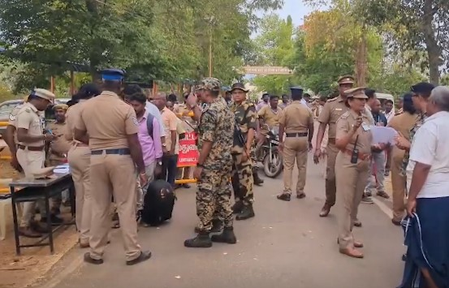
Security measures were heightened at Netaji Indoor Stadium in Kolkata as the vote counting process kicked off.
Chief Minister Mamata Banerjee and the Trinamool Congress (TMC) are vying for a fourth consecutive term against the Bharatiya Janata Party (BJP), which has evolved from a marginal player to a strong contender.
Moving southwards, Tamil Nadu witnessed a remarkable 85.1 percent voter turnout, breaking its own record. The traditional DMK-AIADMK bipolar contest has been disrupted by the entry of actor Vijay’s Tamilaga Vettri Kazhagam (TVK).
Security was beefed up at the DMK headquarters, Anna Arivalayam, as the Assembly election counting began.
Internal surveys and exit projections indicate that while Chief Minister MK Stalin’s DMK-led alliance is leading with projections ranging from 120 to 145 seats, the TVK has emerged as a significant third force.
Data suggests that Vijay’s party could secure a notable 30 percent vote share in specific urban areas like Chennai and Madurai.
In Kerala, the Left Democratic Front (LDF) under Pinarayi Vijayan is striving for a historic third consecutive term, a first in the state’s modern history. However, projections show a close contest, with the Congress-led United Democratic Front (UDF) expected to hover around the 72-seat mark in the 140-member House.
The potential resurgence of the UDF in Kerala is not just a local victory but also a crucial win for the Congress at a national level, showcasing its capacity to lead a major alliance to victory without being a subordinate partner.
In Assam, the BJP-led NDA, led by Chief Minister Himanta Biswa Sarma, seems poised for a third consecutive win as the state presents a consolidated picture.
Exit polls have predicted the NDA securing between 85 and 100 seats in the 126-member Assembly.
Despite forming a six-party front, the Congress-led Opposition in Assam has found it challenging to dismantle the BJP’s robust organizational structure.
