


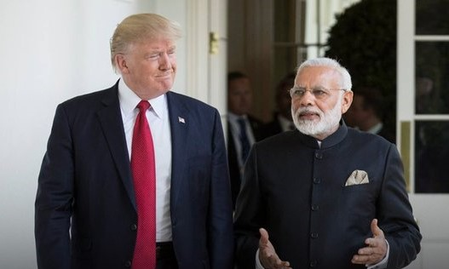
Days after President Donald Trump revealed a trade deal with India, the White House announced that discussions would persist on unresolved tariff and non-tariff barriers. A fact sheet has been released outlining key aspects of the agreement and its implementation roadmap. Negotiations will address remaining tariff barriers, non-tariff barriers, technical trade obstacles, customs and trade facilitation, and regulatory practices.
The two countries will also engage in talks regarding trade remedies, services, investment, intellectual property, labor, environment, government procurement, and unfair practices of state-owned enterprises. Immediate measures agreed upon under the interim framework have been highlighted in the document, while negotiations continue in sensitive areas.
As part of the agreement, President Trump has agreed to eliminate an additional 25% tariff on Indian imports, reflecting India’s commitment to halt oil purchases from Russia. The US will reduce the Reciprocal Tariff on India from 25% to 18%, citing India’s cooperation on trade imbalances and national security concerns. India, in turn, will reduce or eliminate tariffs on American industrial products and various agricultural and food items.
India has committed to expanding purchases from the US, including energy, technology, agricultural products, and coal, amounting to over $500 billion. The agreement also addresses regulatory issues, with a focus on non-tariff barriers in priority areas and negotiations on rules of origin. Digital trade will see India removing digital services taxes and engaging in discussions on bilateral digital trade rules.
Economic security alignment, supply chain resilience, innovation, and technology cooperation are key components of the framework. The US and India aim to enhance bilateral trade in technology products and collaborate on technology advancements. The fact sheet underscores India’s historically high tariffs on US goods and past use of protectionist measures.
The release of the fact sheet follows Trump’s declaration of a national emergency in 2025 over the US goods trade deficit, attributing it to a lack of reciprocity in trade relationships.
