


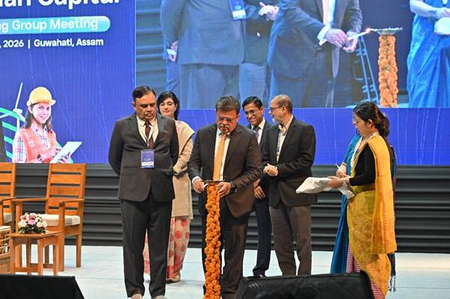
A two-day Working Group Meeting on Human Capital commenced at IIT Guwahati, uniting policymakers, academics, industry leaders, and practitioners to deliberate on preparing India for the era of Artificial Intelligence. Hosted by the Ministry of Electronics and Information Technology (MeitY), the IndiaAI Mission, the Government of Assam, and IIT Guwahati, the discussions on January 5 and 6 revolve around education reform, workforce transition, and the adoption of inclusive AI.
Led by T. G. Sitharam, the meeting serves as a crucial precursor to the India AI Impact Summit 2026 scheduled in New Delhi from February 15 to 20. The outcomes of this gathering in Guwahati are anticipated to influence national policy decisions and enrich global-level dialogues during the summit.
During the inaugural session, key figures like Syedain Abbasi, K. S. Gopinath Narayan, Prof. T. G. Sitharam, Devendra Jalihal, and Shikha Dahiya addressed the audience. They emphasized the pivotal role of human capital in India’s AI journey, advocating for a shift towards lifelong learning and institutional readiness beyond conventional skilling models.
Prof. Devendra Jalihal of IIT Guwahati underscored the institute’s commitment to fostering future-ready human capital by bridging the gap between policymakers, academia, industry, and students. He highlighted the institute’s efforts at the nexus of technology, education, and society, noting a surge in student interest towards building inclusive AI ecosystems.
Shikha Dahiya elaborated on the vision behind the India AI Impact Summit 2026, emphasizing its focus on human capital, democratization of AI resources, and responsible AI adoption, particularly for the Global South. The IndiaAI Mission’s initiatives aim to cultivate talent equipped for the future through enhanced compute capacity, indigenous datasets, models, and extensive AI skilling programs nationwide.
Prof. T. G. Sitharam stressed the necessity for a people-centric and inclusive transition to an AI-driven economy in India. He highlighted the importance of robust lifelong learning systems that not only hone technical skills but also nurture adaptability, judgement, and human values to ensure that technological advancements lead to dignity and opportunities for all.
K. S. Gopinath Narayan from the Government of Assam emphasized the transformative impact of AI on economies and societies, underlining the imperative for continuous learning, micro-skilling, and basic AI literacy as fundamental public capabilities.
