


In this Vijaynagar’er Hirey movie review, we explore a film that arrives like a masterclass in how to make heritage exciting. When was the last time you walked into a theater expecting another detective story and walked out genuinely curious about the Vijayanagara Empire? Vijaynagar’er Hirey doesn’t just entertain; it transforms ancient Indian architecture into living, breathing clues that solve mysteries while celebrating our cultural legacy with infectious intelligence.
Director Chandrasish Ray crafts the fourth Kakababu installment with the confidence of someone who understands exactly what made Sunil Gangopadhyay’s 1988 novel endure. This is Prosenjit Chatterjee reminding us why Kakababu has become Bengali cinema’s most beloved detective, supported by an ensemble cast that understands exactly what kind of thrilling ride they’ve signed up for. With Hampi’s UNESCO World Heritage ruins becoming the film’s co-star and a narrative that makes culture the key to unlocking secrets, Vijaynagar’er Hirey is the cinematic equivalent of that brilliant teacher who made history class feel like an adventure.
Quick Takeaway:
Vijaynagar’er Hirey is a visually stunning, culturally rich mystery thriller that succeeds brilliantly as both entertainment and education. Though some plot twists follow predictable patterns, the film’s intelligent use of heritage as detective work, standout performances, and that satisfying treasure hunt narrative make it essential viewing for families and anyone craving cinema that respects their intelligence.
Language: Bengali
Age Rating: U (Universal – Perfect for family viewing)
Genre: Mystery Thriller, Adventure, Heritage Drama
Director: Chandrasish Ray
The Plot: Treasure Hunt Through India’s Cultural Soul
At its core, Vijaynagar’er Hirey is a treasure hunt—but calling it just that would be like calling the Taj Mahal “some building.” The film’s genius lies in making ancient Indian heritage the actual problem-solving mechanism rather than exotic decoration. When architecture becomes clues, when religious history unlocks secrets, and when understanding Goddess Parvati’s penance at Pampakshetra leads to a lost diamond, suddenly learning feels like the most thrilling activity imaginable.
Raja Roy Chowdhury, aka Kakababu (Prosenjit Chatterjee), and his nephew Shontu (Aryann Bhowmik) begin in Kolkata before embarking on what should be a peaceful Hampi vacation. Of course, peaceful and Kakababu don’t belong in the same sentence. Soon they’re entangled in a dangerous mystery involving a rare diamond hidden somewhere in the ancient ruins of the Vijayanagara Empire’s capital.
The film opens with a pulse-pounding hostage situation in Kolkata—burglars attempting to smuggle precious ancient Indian artifacts, children in danger, and Kakababu delivering that iconic line: “Eta Raja Roy Chowdhury’r shohor, welcome to Kolkata!” (This is Raja Roy Chowdhury’s city, welcome to Kolkata!). It’s a statement of territorial authority that sets the tone perfectly: this is a hero who protects not just people but cultural legacy itself.
Performances: Every Actor Embraces the Heritage Mission
Prosenjit Chatterjee: The Undisputed King Returns
This Vijaynagar’er Hirey movie review must celebrate the obvious: Prosenjit Chatterjee embodies Kakababu with the kind of charismatic authority that reminds you why he’s Bengali cinema’s titan. For four films now, he’s made Raja Roy Chowdhury feel less like a character and more like a cultural institution—intelligent without being condescending, heroic without machismo excess, authentically Bengali while being universally appealing.
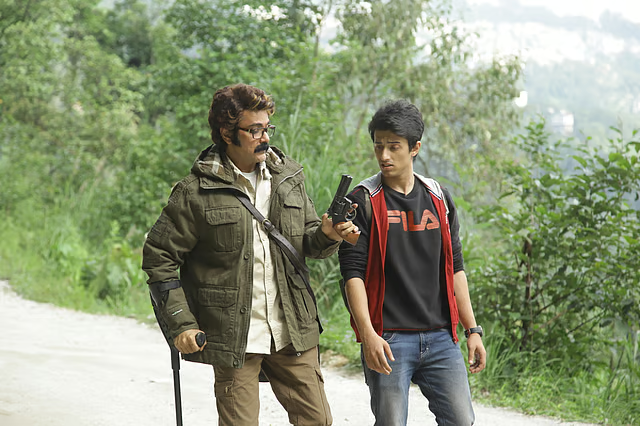
Watch him navigate Hampi’s ruins with the intensity of someone solving a life-or-death puzzle while simultaneously making you believe that understanding ancient architecture is the coolest possible skill. There’s swagger here, certainly—Kakababu knows he’s brilliant—but it’s earned swagger. Prosenjit grounds the character with enough warmth and humanity that we never lose emotional connection, even when the detective work gets deeply technical.
The “happy journey” farewell he gives audiences, his protective instincts when children are threatened, his genuine reverence for Indian heritage—these layers make Kakababu more than a detective; he’s the mentor we all wish we’d had, the uncle who makes learning adventures instead of lectures.
Aryann Bhowmik: The Perfect Nephew Energy
Every great detective needs a Watson, and Aryann Bhowmik’s Shontu provides exactly that youthful enthusiasm and fresh perspective. His chemistry with Prosenjit feels genuinely familial—there’s affection, occasional exasperation, and the kind of unspoken understanding that comes from shared adventures.
Bhowmik brings energy without becoming annoying, curiosity without seeming naive. He’s the audience’s learning conduit, asking questions we might have while being genuinely invested in the mystery. The nephew-uncle dynamic grounds the film emotionally, reminding us that beneath all the heritage and history, this is fundamentally a story about family bonds strengthened through shared purpose.
The Supporting Ensemble: Adding Cultural Texture
- Satyam Bhattacharya brings nuanced intensity to his role, adding layers to the mystery that keep viewers guessing. His performance suggests depths that the narrative smartly doesn’t over-explain.
- Sreya Bhattacharya adds authentic presence to scenes, grounding the more fantastical treasure hunt elements with believable reactions and emotional truth.
- Anujoy Chattopadhyay contributes memorable moments that enhance rather than distract, understanding that in ensemble work, every role serves the larger story.
- Rajnandini Paul brings fresh energy to the narrative, her performance adding contemporary resonance to this heritage-focused tale.
- Chiranjeet Chakraborty, the veteran presence, connects Vijaynagar’er Hirey to Bengali cinema’s rich tradition. His gravitas reminds us that this film stands on the shoulders of decades of quality regional storytelling.
The ensemble succeeds because everyone understands the assignment: serve the mystery, honor the heritage, and trust that audiences will appreciate intelligence over spectacle.
Direction and Vision: Chandrasish Ray’s Heritage Masterclass

Chandrasish Ray directs the fourth Kakababu installment with remarkable assurance, balancing multiple challenging elements: mystery plotting, heritage education, family entertainment, and visual spectacle. What’s most impressive is how effortlessly he makes these elements support rather than compete with each other.
The film’s structure—moving from Kolkata’s urban chaos to Hampi’s ancient serenity—provides natural narrative rhythm. Ray understands that mystery thrillers live and die on pacing, and he maintains tension brilliantly by “disclosing just enough” at every step. We’re never confused, but we’re never ahead of the investigation either. That’s expert plotting.
The inclusion of light-hearted, comical moments even during serious sequences demonstrates Ray’s confidence in his material. He trusts that audiences can handle tonal shifts, that humor doesn’t diminish stakes. This results in a film that breathes naturally rather than suffocating under its own seriousness.
Technical Brilliance: Making Heritage Visually Compelling
Cinematography: Hampi as Living History
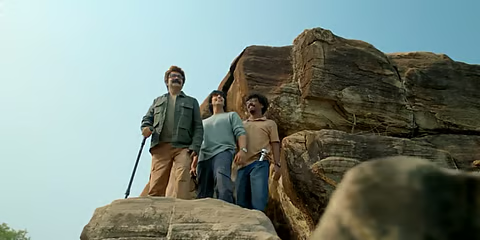
The visual language of Vijaynagar’er Hirey transforms Hampi’s UNESCO World Heritage site into something between documentary reverence and thriller urgency. The cinematography captures the ruins’ grandeur without making them feel museum-dead. These stones have stories, and the camera treats them as active narrative participants.
What’s particularly effective is how the cinematography shifts between scale—wide shots establishing Hampi’s breathtaking scope, then intimate close-ups examining specific architectural details that become clues. This visual grammar trains viewers to look closely, to see heritage as detective work. By the film’s end, you’re not just entertained; you’re genuinely curious about Vijayanagara architecture.
The Kolkata sequences provide effective contrast—urban energy versus ancient serenity, contemporary chaos versus historical permanence. The cinematography makes this geographical shift feel thematically significant rather than merely scenic.
Sound Design and Music: The Stunning Background Score
The background score deserves its own standing ovation. Throughout Vijaynagar’er Hirey, music maintains pulse-pounding tension while respecting the cultural sanctity of Hampi’s setting. It swells during action sequences, pulls back during detective work, and adds emotional resonance without overwhelming dialogue.
What’s brilliant is how the score makes heritage feel thrilling rather than academic. When Kakababu makes connections between ancient history and present mystery, the music celebrates these intellectual victories with the same energy other films reserve for physical action. It’s scoring that honors intelligence.
The sound design enhances immersion—footsteps echoing through ancient temples, wind across ruins, the ambient sounds that make locations feel real rather than constructed. These details matter in creating believable world-building.
Editing: Maintaining Mystery Momentum
Keeping a heritage mystery engaging across its runtime requires surgical editing precision. Vijaynagar’er Hirey succeeds admirably, maintaining narrative clarity while preserving suspense. The mystery unfolds in carefully layered revelations—each clue building on previous discoveries, each scene advancing both plot and character.
The pacing occasionally slows during heritage exposition, but these moments feel educational rather than draggy. Ray and his editing team trust that audiences came for both entertainment and enlightenment. The balance works far more often than not.
Cultural Context: A Love Letter to Indian Heritage
This Vijaynagar’er Hirey movie review must acknowledge the film’s most significant achievement: making Indian heritage thrilling without turning it into spectacle. This isn’t Hampi as tourist attraction; it’s Hampi as living history that holds secrets worth uncovering.
The film educates without lecturing. When we learn about Pampakshetra’s significance to Goddess Parvati’s penance, about the Vijayanagara Empire’s architectural brilliance, about how ancient builders encoded information in temple structures—we learn because this knowledge solves mysteries. Education becomes adventure.
The Bengali cultural specificity—Kakababu’s Kolkata roots, the language’s warmth and poetry, references to regional cinema traditions—grounds the film while never excluding broader audiences. You don’t need to be Bengali to appreciate intelligence, courage, and the thrill of uncovering hidden history.
Strengths and Minor Considerations
What Works Magnificently
- Prosenjit Chatterjee’s commanding Kakababu – Charismatic, intelligent, authentically heroic without excess
- Heritage as narrative tool, not decoration – Ancient culture actively solves mysteries
- Perfect family entertainment balance – Thrilling without inappropriate content, educational without being preachy
- Ensemble cast chemistry – Everyone serves the story effectively
- That exceptional background score – Maintains tension while respecting cultural setting
- Educational value for children – Makes learning Indian history genuinely exciting
- Kakababu’s enduring legacy – Fourth installment proves the character’s lasting appeal
Where Minor Enhancements Could Elevate Further
- Some plot twists follow familiar patterns – Attentive viewers might anticipate certain revelations
- Occasional pacing in heritage exposition – Could streamline slightly without losing educational value
- Requires series familiarity for maximum impact – New viewers might miss some Kakababu legacy appreciation
Final Verdict: 4.5/5 Stars ⭐⭐⭐⭐½
Vijaynagar’er Hirey is exactly what family cinema should be—entertaining, educational, emotionally satisfying, and culturally significant. This Bha Bha Ba movie review celebrates a film that succeeds magnificently in making heritage thrilling, proving that audiences hunger for intelligence alongside entertainment.
Chandrasish Ray has crafted a mystery thriller that respects viewers’ minds while celebrating India’s cultural wealth. Prosenjit Chatterjee reminds us why Kakababu has carved permanent space in Bengali cinema’s pantheon—not through flashy heroics but through intelligent courage, cultural reverence, and genuine warmth. The ensemble cast, from Aryann Bhowmik to Chiranjeet Chakraborty, demonstrates Bengali cinema’s strength: depth of talented performers committed to quality storytelling.
Yes, some plot elements follow predictable patterns. Yes, heritage exposition occasionally slows pacing. But these are minor considerations in a film that swings boldly for something genuinely valuable: cinema that entertains while inspiring curiosity about our own magnificent past.
The Continuing Legacy of Quality Regional Cinema
There’s specific joy in watching a film that refuses to underestimate its audience. In an industry increasingly dominated by lowest-common-denominator formulas, Vijaynagar’er Hirey feels like validation—proof that families will show up for intelligence, that children can handle sophisticated storytelling, that heritage can be as thrilling as any action sequence when presented with imagination and respect.
The Kakababu series, now four films strong, represents something invaluable in regional cinema: consistent quality, cultural authenticity, and the courage to believe that entertainment and education enhance rather than diminish each other. Vijaynagar’er Hirey honors Sunil Gangopadhyay’s literary legacy while creating cinema that stands independently as thrilling, beautifully crafted storytelling.
After the credits roll and you leave the theater, you’ll likely find yourself Googling Hampi’s history, looking up Vijayanagara Empire architecture, exploring the Pampakshetra legends. That curiosity—that desire to learn more about the heritage that surrounds us—is the film’s greatest achievement. Entertainment that educates, mystery that celebrates culture, and cinema that makes you prouder of where you come from.
