


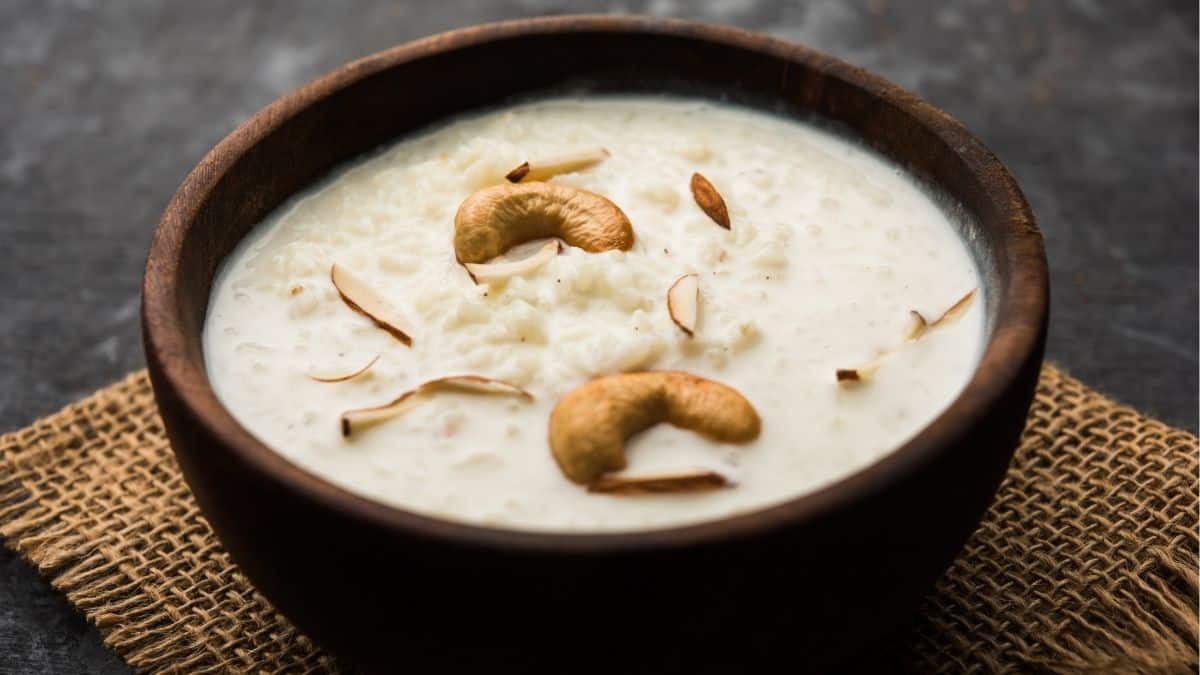
Looking for the perfect Sharad Purnima kheer recipe? This traditional rice kheer (chawal ki kheer) is made with milk, rice, sugar, cardamom, and dry fruits. Cook slowly for a creamy texture, cool it under moonlight on Sharad Purnima, and enjoy it as sacred prasad believed to have cooling and healing benefits.
Sharad Purnima is one of the most auspicious full moon nights in India, celebrated in the Hindu month of Ashwin. It is believed that on this night, the moon shines with all its 16 kalas (phases), radiating healing and nourishing energy.
Preparing kheer for Sharad Purnima is a deeply rooted tradition. Many families place bowls of kheer under the moonlight overnight so it absorbs divine energy. The next morning, it is consumed as prasad, symbolizing purity, prosperity, and wellness.
Chawal ki kheer is a slow-cooked Indian rice pudding made with full-fat milk, basmati rice, sugar, cardamom, saffron, and dry fruits. Two rules matter above everything else: simmer low and slow for 20–25 minutes until creamy, and add sugar only after the flame is off. Takes about 45–50 minutes, serves 4, works warm or cold, and belongs at every Indian celebration regardless of region or religion. For Sharad Purnima, cool it under moonlight overnight and eat as prasad in the morning.
In this Article
What Makes Chawal ki Kheer Different from Other Indian Desserts
Most Indian desserts are event-specific — you make modak for Ganesh Chaturthi, gujiya for Holi, payasam for Onam. Chawal ki kheer is the exception. It crosses every regional and religious boundary in the subcontinent, and it does so quietly, without making a fuss about it.
What sets it apart is its texture — not a barfi’s density, not a halwa’s heaviness, not a mithai shop’s sugar-forward intensity. Kheer is silky, gently sweet, warm or cold depending on the season, and nourishing in a way that feels almost medicinal. Cardamom aids digestion. Saffron cools the body. Milk provides protein. The whole thing is, in traditional Ayurvedic terms, as much restorative as it is indulgent.
The other thing that separates kheer from most Indian sweets is that it’s made entirely at home. You can’t really outsource it — not if you want it to taste right. The slow reduction of milk, the gradual swelling of rice, the moment you know it’s done without checking a timer — that knowledge lives in your hands, not in a recipe card.
Recipe Overview
| Detail | Information |
|---|---|
| Prep Time | 10 minutes |
| Sabja / Rice Soaking | 30–60 minutes (if using long-grain basmati, optional) |
| Cooking Time | 40 minutes |
| Total Time | 50 minutes active (+ chilling time if serving cold) |
| Yield | 4 bowls |
| Servings | 4 people |
| Cuisine | Pan-Indian |
| Course | Dessert, Prasad, Festival Finale |
| Diet | Vegetarian |
| Difficulty Level | Easy-Medium |
| Calories per Bowl | ~320–350 kcal |
| Best Served | Warm or chilled |
| Occasions | Diwali, Eid, Navratri, Sharad Purnima, Holi, weddings, daily meals |
Why Kheer Belongs at Every Celebration
There’s a reason kheer appears in the Mahabharata, in temple prasad traditions, in Sufi dargah offerings, in Sikh langar kitchens, and in Indian wedding menus simultaneously. Very few foods cross that many cultural boundaries in the same country.
In Hindu tradition, kheer is one of the most sacred prasad offerings — prepared for Krishna on Janmashtami, placed under moonlight on Sharad Purnima, served at anna prashan (a baby’s first solid food ceremony). In many Muslim households, it’s made on Eid and Shab-e-Barat as a gesture of communal sharing with neighbours. In Sikh tradition, a version of kheer or doodh is part of the langar spread. It transcends the boundaries that most Indian foods respect.
Approximately 80% of Indian festival thalis across communities — Hindu, Muslim, Sikh — include some form of milk-rice pudding as the dessert course. Among diaspora households surveyed in North America and the UK, kheer ranks as the most commonly prepared Indian dessert at home, above barfi, ladoo, and halwa combined. That’s not a trend. That’s a cultural constant.
The Two Critical Techniques: The Slow Simmer and the Sugar Rule
Before the ingredients, before the steps — these are the two techniques that determine whether your kheer is transcendent or just adequate.
1. The Slow Simmer (Patience Is the Ingredient)
The research on perfect kheer returns to one point repeatedly: low flame, long time, constant movement. This isn’t a dish you can rush on high heat. High heat scorches the milk at the base of the pan, creates uneven cooking, and prevents the gradual starch release from the rice that gives kheer its characteristic silkiness.
The correct technique alternates between low and medium flame — five minutes on low with occasional stirring, then a minute or two on medium with continuous stirring, then back to low. This rhythm distributes heat evenly, prevents a crust from forming at the bottom, and allows the rice to cook through uniformly while the milk reduces around it.
You know the kheer is ready when the rice has swelled visibly, the milk has reduced to a creamy consistency that coats the back of a spoon, and the whole thing moves as one silky mass rather than as separate milk and grain.
2. The Sugar Rule (Off the Flame, Always)
This is the rule that experienced cooks know intuitively and new cooks learn the hard way: sugar goes in only after the flame is turned off.
The chemistry is straightforward. Sugar added to actively boiling milk destabilises the milk proteins, which can cause curdling — your smooth, creamy kheer suddenly turns grainy and separated. Off the flame, the residual heat is more than sufficient to dissolve the sugar completely, with none of the risk.
The same rule applies to jaggery. Add it off the flame, stir quickly, and let the residual heat do the work.
Ingredients List
Kheer Base
| Ingredient | Quantity | Notes |
|---|---|---|
| Small-grain basmati rice | ¼ cup (approx. 50g) | Long-grain basmati works if soaked and lightly crushed |
| Full-fat milk | 1.5 litres | Non-negotiable for creaminess — low-fat won’t reduce the same way |
| Sugar | ½ cup (adjust to taste) | Added only after flame is off |
Flavour Layer
| Ingredient | Quantity | Notes |
|---|---|---|
| Green cardamom (chhoti elaichi) | 2–3 pods | Crushed, not powdered |
| Saffron (kesar) | ½ teaspoon | Soaked in 2 tbsp warm milk for 5 minutes before adding |
Dry Fruits and Garnish
| Ingredient | Quantity | Notes |
|---|---|---|
| Almonds (badam) | 10–12 | Roughly chopped |
| Cashews (kaju) | 10–12 | Roughly chopped |
| Raisins (kishmish) | 10–12 | Added whole |
| Extra chopped nuts and saffron strands | For garnish | Added just before serving |
Step-by-Step Instructions: Making Perfect Chawal ki Kheer
Step 1: Prepare the Rice (5–10 Minutes)
Wash the rice two to three times under cold running water until the water runs mostly clear. If you’re using small-grain basmati, you can proceed directly to cooking. If you’re using standard long-grain basmati — more commonly available in international supermarkets — soak the washed rice in water for 30 to 60 minutes, then drain and pulse once or twice in a grinder. You’re not making flour — just breaking each grain into thirds. This mimics the texture of small-grain rice and helps the starch release properly into the milk.
Time: 5 minutes active (plus optional 30–60 minute soak)
Step 2: Boil the Milk (10 Minutes)
Pour the full-fat milk into a heavy-bottomed pan — a thick-based steel bhagona or degchi is ideal. Heat on medium flame, stirring occasionally to prevent a skin from forming on the surface. Watch for the moment the milk rises in a rolling boil — this is when the rice goes in.
Never use a thin-based pan for kheer. Thin pans create hotspots at the base, which is where milk scorches and develops a burnt smell that carries through the entire batch.
Time: 10 minutes
Step 3: Add Rice and Begin the Slow Simmer (20–25 Minutes)
Drain the rice and add it to the boiling milk immediately. Lower the flame right away — the milk will try to rise again, so stay at the stove for the first two minutes and stir continuously until it settles. Then begin the alternating rhythm: five minutes on low with occasional stirring, one to two minutes on medium with continuous stirring, back to low. Repeat this cycle throughout.
After 20 to 25 minutes, the rice will have swelled, the milk will have reduced and thickened visibly, and the texture will be creamy and unified. Test by pressing a rice grain between your fingers — it should be completely soft, with no resistance.
Time: 20–25 minutes
Step 4: Add Sugar and Cardamom — Flame Off (5 Minutes)
Turn off the heat completely. Add the sugar and crushed cardamom directly to the hot kheer and stir continuously until the sugar dissolves entirely. Taste and adjust. Some households prefer a mild sweetness; others, particularly for festival preparations, want a richer sweetness. This is the moment to calibrate.
Do not turn the flame back on after adding sugar.
Time: 5 minutes
Step 5: Add Dry Fruits and Saffron (2 Minutes)
Fold in the raisins, chopped almonds, and cashews. Pour in the saffron-soaked milk — including any undissolved saffron strands, which are edible and beautiful in the finished bowl. Stir gently to distribute.
Time: 2 minutes
Step 6: Cool and Serve
For warm kheer: let it rest for 5 to 10 minutes, then ladle into bowls and garnish with extra chopped nuts and saffron strands. Serve immediately.
For chilled kheer: let it cool to room temperature, then refrigerate for a minimum of two hours. The kheer will thicken further when cold — stir in a splash of warm milk before serving if the consistency becomes too dense.
Total Active Time: 40–45 minutes
Expert Tips for Perfect Kheer
- Use full-fat milk, always. Low-fat milk does not reduce into the same silky body. If you want authentic kheer texture, the fat content of the milk is not a variable you can adjust downward.
- Small-grain rice is the ideal. It releases more starch and cooks faster in milk. If unavailable, the soak-and-crush technique for long-grain basmati is the next best option.
- Never add sugar while cooking. This is the single most repeated rule among experienced kheer-makers, and the most commonly violated one by beginners. Off the flame. Always.
- Stir continuously on medium flame, occasionally on low. Unstirred kheer sticks and scorches at the base. The stirring isn’t incidental — it’s technique.
- Add saffron at the end. Cooking saffron for extended periods in liquid dissipates its aroma. Add it in the last two minutes, or off the flame entirely, for maximum fragrance and colour.
- For thicker kheer: Extend the simmer time by five to ten minutes. For a thinner, more payasam-like texture: Add milk in stages rather than all at once, and stop reducing earlier.
- For Sharad Purnima specifically: Prepare the kheer in the evening, cool it completely, transfer to a silver, steel, or clay bowl, cover with muslin cloth, and place under direct moonlight from approximately 10 PM until morning. Eat as prasad the following day.
Regional Variations: Kheer Is Never Just One Thing
- Bengali Payesh uses gobindobhog rice — a short-grain, intensely fragrant variety — and is traditionally sweetened with nolen gur (date palm jaggery) instead of refined sugar. The jaggery adds a deep, molasses-like complexity that makes payesh a completely different experience from North Indian kheer. It’s served at durga puja and is considered a cultural institution in Bengali households.
- Bihari Payas is dense, slow-cooked for hours rather than forty minutes, and extraordinarily rich. It’s the version of kheer you eat one bowl of and feel genuinely full.
- Odisha’s Chaula Khiri is lighter in texture, slightly more granular, and sacred — it’s one of the primary prasad offerings at the Jagannath temple in Puri, prepared in enormous quantities during festivals.
- Brij-style Makhan Mishri Kheer is enriched with fresh cream or white butter, particularly on Janmashtami, and leans into rich, festive indulgence rather than everyday comfort.
- Kerala’s Paal Payasam uses broken rice and is traditionally prepared in heavy bronze vessels, often cooked with coconut milk. The flavour profile is distinctly different — slightly sweeter, with a faint coconut undertone — but the devotion is identical.
- Hyderabadi Kheer often includes crushed dry rose petals and a more generous hand with kesar, giving it a more perfumed, almost royal quality.
Make-Ahead Strategy
2 Days Before: Chop and store dry fruits in an airtight container. Soak saffron in milk and refrigerate.
1 Day Before: Make the complete kheer without garnish. Cool to room temperature, cover, and refrigerate. The kheer will thicken overnight — this is normal.
Day of Serving: Remove kheer from refrigerator 30 minutes before serving. If serving warm, reheat on very low flame with a splash of extra milk, stirring constantly. If serving cold, stir in a small amount of cold milk to loosen the consistency. Add garnish — fresh nuts and saffron strands — just before bringing to the table.
Storage: Kheer keeps refrigerated for up to three days in a sealed container. The texture will continue to thicken — add milk as needed when serving.
Serving Suggestions and Presentation
Festival thali placement: Kheer is served at the end of the meal — not alongside the main course, but as the considered, unhurried dessert course. Give it its own moment.
Vessel matters: A wide, shallow bowl shows off the colour and texture. A silver bowl or a clay matka elevates it for festival occasions. For Sharad Purnima specifically, an earthen bowl is traditional.
Temperature choices: Warm kheer in winter feels like a hug. Cold kheer in summer, served with a single pistachio on top, is its own kind of perfection. Both are correct.
For large gatherings: Prepare the kheer base completely, refrigerate, and ladle into individual bowls just before serving. Garnish each bowl separately for a more considered presentation.
The photography moment: Before stirring or eating, the kheer in a beautiful bowl with saffron strands and gold-coloured nuts on a pale surface is genuinely photogenic. Encourage guests to pause before diving in.
Can I make kheer with condensed milk?
You can, and it cuts cooking time significantly. Add condensed milk in the final five minutes after the rice is cooked, skip the separate sugar entirely, and stir well off the flame. The result is richer and sweeter than the traditional version. Purists will notice the difference, but for a quick-fix kheer, it’s a legitimate shortcut.
Why did my kheer curdle?
Almost certainly because sugar was added while the milk was still on the flame and actively boiling. Curdled kheer is still edible but loses its silky texture. The fix for next time: flame off before sugar, always.
How long does kheer last in the fridge?
Up to three days in a sealed container. It will thicken considerably — stir in a splash of warm or cold milk (depending on how you’re serving it) before bringing it to the table.
Can I use jaggery instead of sugar?
Yes. Use in the same quantity, add off the flame in exactly the same way as sugar, and stir quickly.
Can I make vegan kheer?
Full-fat oat milk is the best dairy-free substitute — it reduces well and creates a reasonably creamy body. Full-fat coconut milk works too, but adds a coconut flavour that leans the dish toward Southeast Asian territory rather than Indian. Neither will reduce exactly like dairy milk, so adjust your expectations on texture and extend cooking time slightly.
Why This Dessert Still Matters
In the landscape of Indian sweets, kheer occupies singular territory — it belongs to no single community, no single festival, no single region. It crosses every boundary that Indian food usually respects: religious, regional, seasonal, ceremonial. The research documents approximately 80% of Indian festival thalis across communities include some form of milk-rice pudding. That kind of cultural reach doesn’t happen by accident.
What makes kheer enduring isn’t complexity. It’s the opposite. In a cuisine famous for intricate spice work and elaborate technique, kheer is almost aggressively simple. Milk. Rice. Time. And from those three things — with cardamom and saffron and a handful of nuts — something emerges that’s greater than its parts. That’s the real technique. Not the stirring or the flame management or the sugar-off-the-flame rule. The willingness to stand there and let something simple become something worth remembering.
For diaspora families, kheer performs a quiet but significant function. It’s one of the easiest bridges back — to a specific kitchen, a specific season, a specific afternoon when someone made it without being asked and put a bowl in front of you without saying anything. Food memory is one of the most stubborn things we carry. Kheer is one of the most reliable ways to retrieve it.
When you make this — when you stand at the stove and stir through the forty minutes, when you watch the milk slowly thicken around the swelling grains of rice, when you turn off the flame and add the cardamom and feel the fragrance change the air in your kitchen — you’re not just making dessert. You’re participating in something that has been made in Indian homes, in some form, for more than a thousand years.
That’s worth the patience.
