


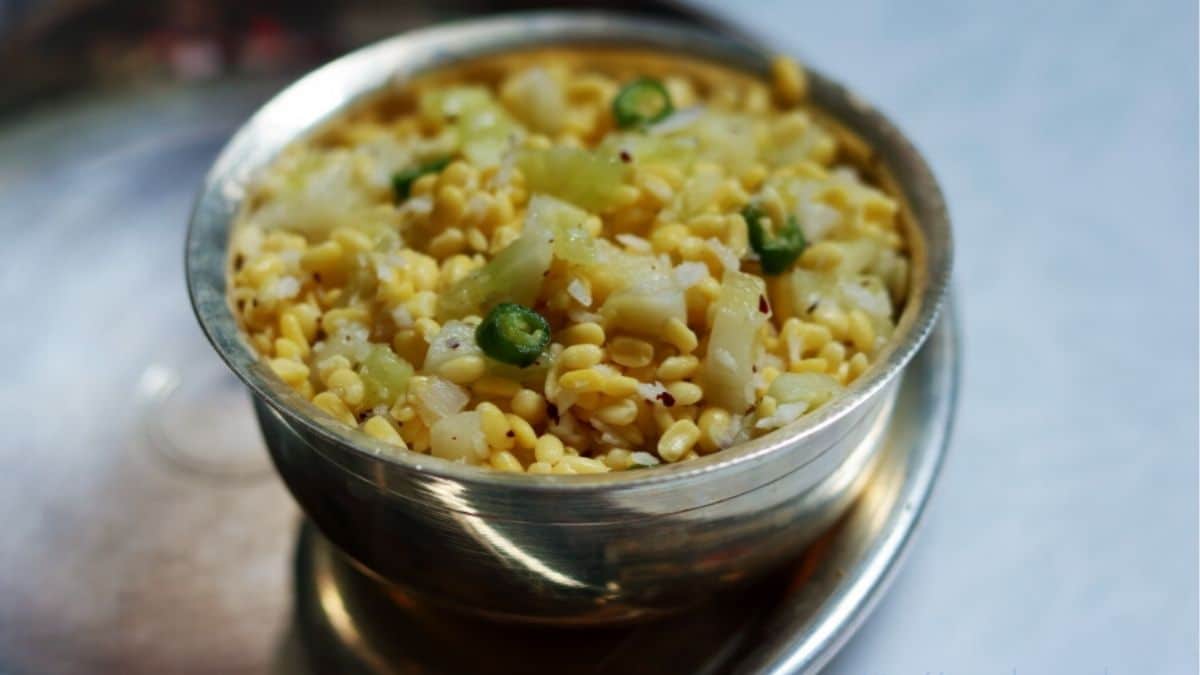
There are certain offerings that carry their meaning not in their complexity but in their restraint — where the simplicity of the ingredients is itself the point, where the act of soaking and draining and mixing becomes a quiet ritual of devotion. Vada Pappu, the no-cook moong dal salad offered as neiveidyam on Narasimha Jayanti, is exactly that kind of prasadam.
Narasimha Jayanti celebrates the appearance of Lord Vishnu in his fierce half-lion, half-human avatar — the day he emerged from a pillar to protect his devotee Prahlada and vanquish Hiranyakashipu. It is observed with fasting, puja, and a neiveidyam spread rooted in the Telugu Vaishnava tradition. Vada Pappu, offered alongside Panakam and Neer Mor, is one of the three essential offerings of this festival — cooling, sattvic, and prepared without fire, honoring the purity that the occasion demands.
If you grew up in a Telugu household, you know this salad not by recipe but by muscle memory. The moong dal soaking in a steel bowl since morning. The fresh coconut grated right before mixing. The single green chilli chopped small. Nothing elaborate, nothing showy — just clean, honest food offered with full hands and a quiet heart.
Vada Pappu is a traditional Telugu no-cook moong dal salad offered as prasadam on Narasimha Jayanti, alongside Panakam and Neer Mor, as part of the sacred neiveidyam trio. Made with just soaked split yellow moong dal, fresh grated coconut, green chilli, and salt, the entire recipe comes together in 35 minutes with only 30 of those being passive soaking time.
In This Article
What Makes Vada Pappu Special?
Vada Pappu exists in the same family as Karnataka’s Kosambari, but it is distinctly Telugu in character and festival identity. What sets it apart is its radical simplicity — no tadka, no lemon, no layering of spices. The beauty of this dish is that it trusts the natural flavour of soaked moong dal to do the heavy lifting, and it delivers every time.
The soaked split yellow moong dal has a mild, earthy sweetness that pairs beautifully with the richness of fresh grated coconut. The green chilli cuts through with just enough heat to keep things interesting without disrupting the sattvic spirit of the offering. Salt ties it all together. That’s genuinely all there is to it — and yet the result is something that feels complete, nourishing, and quietly festive all at once.
Unlike cooked prasadam, Vada Pappu requires no flame. This no-cook quality makes it especially appropriate as a neiveidyam offering on Narasimha Jayanti, a day when many devotees observe strict fasting and the kitchen is kept as pure and minimal as possible.
Recipe Overview
| Detail | Information |
|---|---|
| Prep Time | 5 minutes |
| Soaking Time | 30 minutes (passive) |
| Cook Time | Nil |
| Total Time | 35 minutes |
| Yield | 2 servings |
| Cuisine | Telugu, South Indian |
| Course | Prasadam, Festival Neiveidyam |
| Diet | Vegan, Gluten-Free, Oil-Free |
| Difficulty | Very Easy |
| Calories per Serving | ~193 kcal |
| Festival | Narasimha Jayanti |
Why Vada Pappu Is Essential for Narasimha Jayanti Neiveidyam
Narasimha Jayanti is observed on the Chaturdashi tithi of Shukla Paksha in the month of Vaishakha — a full moon-adjacent evening of intense devotion. The prasadam offered on this day carries specific spiritual significance, and Vada Pappu plays a distinct role within it.
Sattvic, fire-free offering. Vada Pappu requires no cooking, making it one of the purest forms of neiveidyam — untouched by oil, flame, or heavy spices. This quality aligns with the spiritual intention of the day.
Part of the sacred trio. Alongside Panakam and Neer Mor, Vada Pappu completes the classical neiveidyam spread associated with Telugu Vaishnava festivals. These three together — sweet, sour, and savoury — represent a complete, balanced offering to the Lord.
Seasonally appropriate. Narasimha Jayanti falls in the height of Indian summer. Soaked moong dal is cool and easily digestible, precisely what the body needs when fasting through a warm day and breaking the fast in the evening.
Cooling and protein-rich. For devotees who fast all day, Vada Pappu provides a gentle, high-protein way to ease back into eating — light enough not to overwhelm a fasting stomach, nourishing enough to genuinely restore energy.
Deeply regional and devotional. In Andhra Pradesh and Telangana, this offering is not a choice but a given. It is what is made, what is offered, and what is eaten — generation after generation, with very little changing and nothing needing to.
The One Critical Technique: Getting the Soak Right
Before we go into the full recipe, it’s worth pausing on the only technique that truly matters here — because Vada Pappu has no cooking, no tempering, and no margin for error beyond this single step.
Soak for exactly 30 minutes — not less, not more.
Under-soaked moong dal is chalky and hard at the centre, unpleasant to eat raw and difficult to digest. Over-soaked dal — anything beyond 45 minutes — starts to turn slightly fermented in warm weather, losing its clean fresh flavour and becoming soft to the point of mush.
Thirty minutes in room-temperature water gives you dal that is just tender throughout, retaining its shape, its mild sweetness, and its satisfying bite. That’s the whole technique. Everything else is just mixing.
Vada Pappu Ingredients
Base Components
| Ingredient | Quantity | Notes |
|---|---|---|
| Split yellow moong dal | ½ cup | Dhuli moong / pesarapappu |
| Green chilli | 1 | Finely chopped |
| Fresh grated coconut | 1½ tablespoon | Fresh is strongly preferred |
| Salt | To taste | Add just before serving |
Optional Add-Ins
| Ingredient | Notes |
|---|---|
| Grated raw mango | Adds tartness; traditional summer variation |
| Chopped cucumber | Adds crunch and extra cooling effect |
| Grated carrot | Turns it into a fuller kosambari-style dish |
| Squeeze of lemon juice | Brightens flavour if raw mango unavailable |
Step-by-Step Instructions: Making Perfect Vada Pappu
Step 1: Wash and Soak the Moong Dal (30 Minutes Passive)
Measure out ½ cup of split yellow moong dal and wash it two to three times in cold water, gently rubbing the dal between your palms, until the water runs mostly clear. Then soak it in enough fresh water to fully submerge the dal, for exactly 30 minutes.
Use room-temperature water, not warm — warm water accelerates softening unevenly and can make the dal mushy on the outside while the centre is still firm.
Time: 30 minutes passive soaking
Step 2: Drain Completely (5 Minutes)
After 30 minutes, pour the dal through a fine mesh strainer or colander and let all the water drain fully. Shake the strainer gently to release excess moisture. You want the dal to feel moist but completely dry on the surface — excess water sitting in the bowl will dilute the coconut flavour and make the salad watery.
If you have time, let it drain for a full five minutes. If you’re preparing this as prasadam, this is the moment to offer a quiet intention.
Time: 5 minutes
Step 3: Mix and Season (2 Minutes)
Transfer the drained moong dal into a clean mixing bowl. Add the finely chopped green chilli, fresh grated coconut, and salt. Toss everything together gently but thoroughly, making sure the coconut and chilli are distributed evenly through the dal rather than sitting in one clump.
Taste and adjust salt. The flavour should be clean, mildly sweet from the coconut, gently spiced from the chilli, and quietly earthy from the dal itself.
Time: 2 minutes
Step 4: Add Optional Variations (2 Minutes)
If you’re including raw mango, cucumber, or carrot, fold them in now with a light hand. These should complement the dal rather than overpower it — keep quantities modest.
Time: 2 minutes
Step 5: Offer and Serve Fresh
Vada Pappu is ready to be offered as neiveidyam. Place it in a small, clean bowl as part of the prasadam spread alongside Panakam and Neer Mor. After the offering, serve fresh to family and guests. This dish is at its best the moment it is made.
Total Active Time: 10 Minutes (plus 30 minutes soaking)
Expert Tips for the Best Vada Pappu
- Fresh coconut is non-negotiable if you can help it. Desiccated coconut has neither the moisture nor the natural sweetness of fresh grated coconut, and in a dish this simple, that difference is clearly tasted. If you must substitute, hydrate desiccated coconut briefly in a spoon of warm water before using.
- Don’t over-soak the dal. Thirty minutes is the exact window you want. Set a timer and pull the dal out on time, especially in summer when warm ambient temperatures speed up the softening process.
- Add salt just before mixing and serving, not during soaking. Salt draws moisture out of the dal and can make it soft and waterlogged if added too early.
- Skip the chilli for very young children or strict fasting observers. The dish holds together beautifully without it — the coconut provides enough flavour contrast on its own.
- Raw mango is a seasonal gift. When sour green mangoes are in season, grate a small amount into Vada Pappu for a tartness that is genuinely wonderful and very traditional.
- For a slightly softer texture, parboil the soaked dal for just 2 to 3 minutes, drain, cool completely, then mix as above. This is a common variation for older family members or young children.
- To make it a full meal salad outside of the festival context, add grated carrot, a small tadka of mustard seeds and curry leaves, and a squeeze of lemon. This takes it into full kosambari territory — equally delicious.
Regional Variations and Adaptations
With raw mango: The most beloved summer variation — grated green mango adds a sour brightness that works beautifully against the sweet coconut and earthy dal. Common in coastal Andhra households.
With cucumber: Chopped cucumber adds crunch and an additional cooling effect, making the salad even more refreshing for breaking a summer fast.
Kosambari style (Karnataka): A mustard-jeera tadka, grated carrot, coriander leaves, and lemon juice transform Vada Pappu into its Karnataka cousin. Equally festive, differently spiced.
Parboiled version: Lightly cooking the soaked dal gives a softer texture while keeping the dish mostly no-cook in spirit. Good for those who find raw soaked dal too firm.
Vegan and allergen notes: The base recipe is naturally vegan, gluten-free, oil-free, and nut-free. It requires no adaptation for most dietary needs.
Make-Ahead Strategy for Narasimha Jayanti
Morning of the festival:
- Wash and set the moong dal to soak 30 to 40 minutes before you need it
- Grate the coconut and keep covered in the fridge
- Chop the green chilli and keep aside
At neiveidyam time:
- Drain the dal, mix all ingredients, season, and offer fresh
- Do not assemble more than 30 minutes before serving — the salad is at its best freshly mixed
Storage: Vada Pappu keeps in an airtight container in the fridge for up to 2 days. Give it a gentle toss before serving and re-check the salt. Do not freeze — the dal texture deteriorates completely once frozen and thawed.
Serving Suggestions and Presentation
As neiveidyam: Serve in a small, clean steel or silver bowl as part of the Narasimha Jayanti prasadam spread. Place it alongside Panakam and Neer Mor for the complete traditional trio.
As a light meal: Outside of festival context, Vada Pappu makes a genuinely excellent summer lunch salad. Serve at room temperature or lightly chilled, with a side of buttermilk.
For large gatherings: Scale the recipe easily — the ratio of dal to coconut to chilli remains the same regardless of quantity. Mix in batches to keep the texture even.
Garnish options: A small pinch of freshly grated coconut on top and a thin chilli round on the side keeps the presentation clean and inviting without over-styling a dish that is meant to feel simple.
Why This Dish Still Matters
In a festival calendar full of elaborate sweets and layered preparations, Vada Pappu stands out precisely because it refuses to be elaborate. It asks you to soak, drain, mix, and offer — and in that economy of effort, there is something genuinely moving. The trust this dish places in its ingredients, and the trust the tradition places in its simplicity, is itself a kind of devotion.
Lord Narasimha’s story is one of fierce, unexpected grace — protection that came from an impossible place, in an impossible form, at the exact moment it was needed. That Prahlada’s faith was answered not with grandeur but with presence feels connected, somehow, to the way this festival’s food works too. No performance, no complexity. Just what is needed, offered cleanly and with full attention.
When you set that small bowl of Vada Pappu before the deity on Narasimha Jayanti — the pale yellow dal, the white shreds of coconut, the quiet heat of a single green chilli — you are offering something that has been offered in Telugu households for generations. Nothing has been added. Nothing needs to be.
