


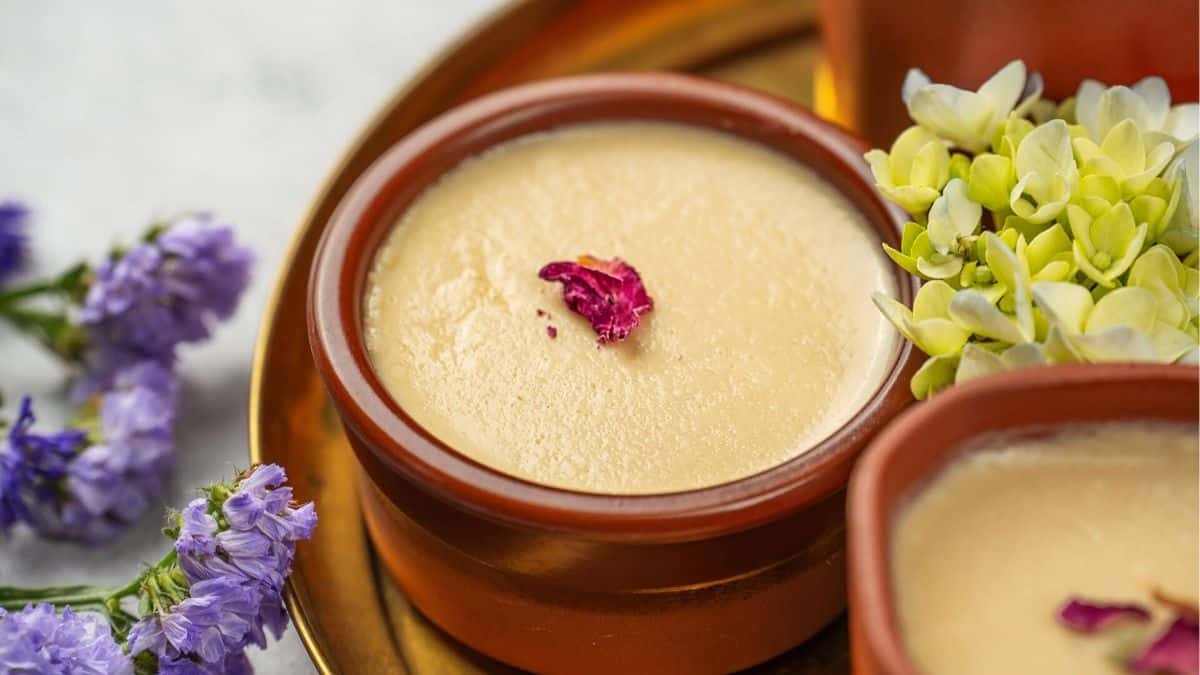
There are certain desserts that don’t just end a celebration — they are the celebration. Desserts where the process itself is a ritual, where patience is an ingredient, where you understand something about the culture simply by making it. Mishti Doi, the caramel-hued sweet yogurt of Bengal, set slowly in earthen clay pots and served cold, is exactly that kind of sweet.
Basanto Utsav is Bengal’s spring festival rooted in Rabindranath Tagore’s Santiniketan tradition, celebrated on the full moon of Dol Purnima. It is Holi, but quieter. Abir instead of water, Rabindra Sangeet instead of loud music, yellow cotton sarees and marigolds instead of neon gulal. And in every Bengali household marking the day, there is a small earthen pot sitting in a warm corner of the kitchen, quietly doing its work. Mishti Doi does not need fanfare. It sets in its own time, on its own terms — and arrives at the table already perfect.
Mishti Doi is traditional Bengali sweet yogurt made with reduced full-fat milk, nolen gur (date palm jaggery), and a yogurt starter — set in earthen clay pots over 7–24 hours and served cold. It is inseparable from Bengali celebrations and the perfect dessert for Basanto Utsav, Bengal’s Tagore-inspired spring festival on Dol Purnima. Two critical techniques: reduce milk to half its volume (do not rush), and add the yogurt starter only at 40–44°C (too hot kills the culture; too cold and it won’t activate). Just 3 core ingredients, 35 minutes active cooking, earthen pots mandatory for authentic texture. Make 1–2 days ahead, refrigerate once set, serve chilled.
Table of Contents
What Makes Mishti Doi Special
Mishti Doi (মিষ্টি দই) is not simply sweet yogurt. The name translates directly — mishti meaning sweet, doi meaning curd — but the translation does nothing for you until you understand the method. This is not dahi with sugar stirred in. Mishti Doi begins with whole milk reduced to half its volume on a slow flame, then sweetened with nolen gur (date palm jaggery), cooled to an exact temperature window, whisked with a live yogurt culture, poured into terracotta pots, and then left — completely undisturbed — for up to 24 hours to ferment and set.
The result is dense, thick, gently tangy, and caramel-coloured with a flavour that is impossible to fully describe: smoky and sweet and faintly earthy, with the particular aroma of jaggery that no sugar can replicate. That distinctive depth comes from the nolen gur, and that perfect texture comes from the clay. The porous walls of a terracotta or earthen pot slowly absorb the excess moisture from the yogurt as it ferments, creating a firmness and density that no glass or steel bowl can achieve. This is why authentic Mishti Doi is always set in a matir bhaand.
Mishti Doi is beloved beyond Bengal — it is a festival staple in Odisha, Assam, Tripura, and the Bogra district of Bangladesh, where the local version is considered one of the finest in the world. But it is Kolkata, and its legendary mishti-r dokans with their rows of stacked clay pots, that made it iconic.
Recipe Overview
| Detail | Information |
|---|---|
| Prep Time | 5 minutes |
| Cook Time | 30 minutes |
| Setting Time | 7–24 hours (passive) |
| Total Time | 35 minutes active |
| Yield | 4 earthen pots |
| Servings | 4 people |
| Cuisine | Bengali |
| Course | Dessert, Festival Sweet |
| Diet | Vegetarian |
| Difficulty Level | Easy–Medium |
| Calories per Serving | ~200 kcal |
| Festival | Basanto Utsav / Dol Purnima |
Why Mishti Doi Is Essential for Basanto Utsav
Basanto Utsav is the spring festival that Rabindranath Tagore introduced at Visva-Bharati University in Santiniketan in the 1920s — drawing from Bengal’s own Dol Jatra tradition but reimagining it as a celebration of music, poetry, and the philosophy of spring. Students dress in basanti yellow and white, weave flowers into their hair, and walk through the campus singing Tagore’s songs. Abir is exchanged gently. There is no chaos, only beauty.
In Bengali homes observing the day, the kitchen carries its own rituals. Mishti Doi is made because spring arrived, and spring deserves sweetness. The dessert is served as the cool, quiet close to a festive meal — after the spiced curries and fried preparations, after the noise and the colour, a small clay pot of cold sweet curd is the thing that settles everything.
There is also an older belief embedded in Bengali food culture: eating mishti doi before stepping out for any important endeavour brings good fortune. It is the same impulse behind the dahi-shakkar eaten before exams — the understanding that something cool and sweet clears the body, steadies the mind, and sends you into the world with a full heart. On Basanto Utsav, when the year feels new and spring feels like possibility, that belief takes on a particular resonance.
Mishti Doi is also a make-ahead festival dessert — set it the night before, refrigerate, and it is ready to serve cold on the day. For a celebration where the kitchen is already busy, that patience built into the recipe is a genuine gift.
The Two Critical Techniques
1. Slow Milk Reduction to One-Third or Half Volume
This is the foundation of Mishti Doi’s texture. The milk must be simmered on a low to medium-low flame, stirred often, with the dried milk solids scraped from the sides and added back into the pot. You are concentrating the milk — thickening it, deepening its flavour, and creating the rich, dense base that distinguishes Mishti Doi from plain yogurt. Do not rush this step. The reduction cannot be shortcut.
2. The Exact Temperature Window for Adding the Starter
This is where most failures happen. After reduction and jaggery, the sweetened milk must cool to exactly 40–44°C before the yogurt starter is added. Too hot, and the live culture dies — your doi will not set. Too cold, and the culture won’t activate — same result. The test without a thermometer: dip a clean finger into the milk. It should feel comfortably warm, not hot. If you have a cooking thermometer, use it. That narrow window is the entire game.
Ingredients
For the Mishti Doi
| Ingredient | Quantity | Notes |
|---|---|---|
| Full-fat whole milk | 1 litre | Do not substitute toned or low-fat milk |
| Nolen gur (date palm / khejur jaggery) | 175–180g (¾ cup, finely chopped) | Substitute: patali gur, then organic dark brown sugar |
| Plain curd / yogurt starter | 2 tablespoons | Room temperature; Greek yogurt or hung curd also works |
| Green cardamom powder | ½ teaspoon | Optional but recommended |
You Will Need
- 4 earthen / terracotta / matir bhaand pots or bowls
- A heavy-bottomed kadai or pan
- A cooking thermometer (optional but strongly recommended)
- Aluminium foil or lids for covering
Step-by-Step Instructions: Making Perfect Mishti Doi
Step 1: Reduce the Milk
Pour 1 litre of full-fat whole milk into a heavy-bottomed kadai or pan. Heat on a low to medium-low flame, stirring occasionally, and bring to a boil. Once boiling, continue to simmer on low heat, stirring frequently. Scrape the dried milk solids from the sides of the pan and add them back into the milk — do not discard them. Continue simmering until the milk reduces to approximately one-third to one-half of its original volume. This slow reduction is the foundation of the texture — it cannot be skipped or shortened.
Time: 30 minutes
Step 2: Rest and Dissolve the Jaggery
Remove the pan from heat and allow the milk to cool for 8 to 9 minutes. When the temperature reaches approximately 60–65°C, add the finely chopped or grated nolen gur. Stir thoroughly until the jaggery is completely dissolved — no lumps. Add the cardamom powder if using, and mix well. The milk will darken to a warm caramel-amber colour as the jaggery dissolves.
Time: 8–9 minutes
Step 3: Reach the Setting Temperature
Allow the sweetened milk to continue cooling, stirring occasionally. You are waiting for the milk to reach 40–44°C — comfortably warm to the touch, not hot. If using a thermometer, confirm the range before proceeding. This step cannot be rushed. Adding the starter too early is the most common reason Mishti Doi fails to set.
Time: 15–20 minutes passive cooling
Step 4: Add the Starter and Whisk
Add 2 tablespoons of room-temperature plain curd or yogurt starter to the warm sweetened milk. If using Greek yogurt or hung curd, first whisk it smooth in a small bowl with 2–3 tablespoons of the warm milk, then add the full mixture to the pot. Whisk thoroughly until the culture is fully and evenly incorporated. The mixture should be smooth and uniform.
Time: 5 minutes
Step 5: Pour Into Earthen Pots and Set
Pour the mixture carefully into earthen or terracotta pots or bowls. Cover each with a lid or seal tightly with aluminium foil. Place in a warm, undisturbed spot — near the kitchen stove, inside a switched-off oven with only the light on, or wrapped in a thick cloth in a warm corner of the room. Do not move or disturb the pots once placed.
Setting time: 7–9 hours in warm weather, up to 24 hours in cooler climates or air-conditioned homes. When set, the Mishti Doi will look firm with a gentle, slight wobble at the centre.
Time: 7–24 hours passive
Step 6: Refrigerate and Serve Cold
Once set, transfer the earthen pots to the refrigerator immediately. Never store at room temperature — the curd will continue to ferment, turn sour, and spoil. Serve chilled, straight from the fridge. Cold Mishti Doi is the only Mishti Doi.
Total Active Time: 35 minutes + 7–24 hours passive setting
Expert Tips for Perfect Mishti Doi
- Always use full-fat whole milk. Toned or low-fat milk often curdles when jaggery is added and will not reduce to the correct consistency. There is no workaround here.
- Chop or grate the jaggery finely before adding so it dissolves quickly and evenly. Small undissolved lumps create uneven colour and texture throughout the doi.
- Temperature control matters more than anything else. Use a thermometer if you have one. That 40–44°C window for adding the starter is the single most critical variable in this entire recipe.
- Do not move or stir the curd once poured into the pots. Even gentle disturbance during fermentation is one of the most common causes of Mishti Doi not setting properly.
- If your home is cold or air-conditioned overnight, place the covered pots in a switched-off oven with only the oven light on. The gentle ambient warmth creates the ideal fermentation environment without overheating.
- The earthen pot is not optional. The porous clay walls absorb excess moisture from the yogurt, creating the dense texture Mishti Doi is known for. A glass or steel bowl will give you sweet yogurt — not Mishti Doi. Indian grocery stores and Asian supermarkets in diaspora cities usually carry terracotta pots. They are worth seeking out.
Regional Variations and Adaptations
- Bogra-r Mishti Doi — From the Bogra district of Bangladesh, this version uses particularly high-fat milk and is widely considered the benchmark of the dish. Bengalis from Bangladesh will argue for it passionately, and they are not wrong to.
- Bhapa Doi (steamed sweet yogurt) — The quick cousin of Mishti Doi, made by whisking condensed milk with yogurt and nolen gur, then setting in a water bath in the oven. Same flavour profile, significantly shorter timeline. Popular among diaspora cooks when time is short.
- Instant Nolen Gurer Mishti Doi — The diaspora-friendly no-cook version using hung curd or Greek yogurt, nolen gur, and warm milk. Sets overnight in the fridge. An honest shortcut for when Basanto Utsav appears on the calendar faster than expected.
- Assamese Meetha Doi — The Assamese version of the same tradition, with slight regional variations in the jaggery used and the fermentation method, but recognisably the same heart.
- Vegan Mishti Doi — Full-fat coconut milk reduced and sweetened with nolen gur, set with a plant-based yogurt starter. The coconut adds its own richness and the jaggery depth carries through. Not traditional, but a genuine alternative for plant-based households.
Make-Ahead Strategy for Basanto Utsav
Two Days Before
- Source nolen gur, earthen pots, and full-fat milk
- Ensure you have a live yogurt starter at room temperature
The Evening Before
- Reduce milk, dissolve jaggery, cool to temperature
- Add starter, pour into earthen pots
- Leave to set overnight in a warm, undisturbed spot
Festival Day
- Confirm the Mishti Doi has set with a gentle wobble at the centre
- Transfer to refrigerator immediately
- Serve chilled as dessert after the Basanto Utsav meal
- Garnish with sliced almonds or pistachios just before serving, if desired
Mishti Doi keeps well refrigerated for 5 to 6 days — meaning you can make it with complete confidence two days ahead without any loss of quality.
Serving Suggestions and Presentation
Serve Mishti Doi cold, in the earthen pots it was set in — the matir bhaand is part of the presentation and part of the taste. No garnish is necessary. If you want to dress it up for a festive table, a few slivers of almond or pistachio placed on top just before serving add colour and a gentle crunch without competing with the flavour.
Mishti Doi works as the quiet, cool close to a full Basanto Utsav meal — after mustard fish, Mangsho Bhaat, lentil preparations, and fried snacks, the chilled sweetness of a small clay pot is the thing that completes the meal rather than extends it. It pairs naturally with Sandesh, Nolen Gurer Payesh, or any of the other Bengali sweets that appear on a festival table.
For large gatherings, set individual pots for each guest rather than one large container — the individual earthen pot is part of the ritual and the pleasure.
Why This Dessert Still Matters
In the landscape of Bengali festival sweets, Mishti Doi occupies a particular kind of territory. It is not the showpiece — Sandesh gets the visual drama, Rasgulla gets the fame, Nolen Gurer Payesh gets the poetry. Mishti Doi is quieter than all of them. It sits in its small clay pot and asks nothing of you except patience.
And perhaps that is the point. Basanto Utsav is a festival that Tagore built around the idea that spring should be welcomed with slowness and beauty — with music instead of chaos, with flowers instead of synthetic colour. Mishti Doi fits that spirit perfectly. It sets in its own time. It arrives cold and calm. And when you eat it — especially if you eat it outside, with abir still faintly on your hands and a Rabindra Sangeet still somewhere at the back of your memory — it tastes like exactly what it is. Spring, in a clay pot.
What is the difference between Mishti Doi and regular dahi?
Regular dahi is plain, unsweetened yogurt. Mishti Doi is sweetened with jaggery or sugar, made with reduced whole milk for a richer, thicker texture, and fermented for longer — resulting in a denser, creamier, caramel-flavoured curd.
What is nolen gur and can I substitute it?
Nolen gur is date palm jaggery — a winter ingredient extracted from the sap of date palm trees. It gives Mishti Doi its signature amber colour and smoky-sweet depth. If unavailable, use patali gur or organic dark brown sugar as a substitute.
Why is Mishti Doi made in earthen pots?
The porous walls of terracotta or clay pots absorb excess moisture from the yogurt as it ferments, creating the dense, thick texture Mishti Doi is known for. They also maintain an ideal temperature for the culture to grow.
How long does Mishti Doi take to set?
In a warm kitchen or climate, Mishti Doi takes 7–9 hours to set. In cooler conditions or air-conditioned homes, it may need up to 24 hours. Always keep it undisturbed in a warm spot during this time.
