


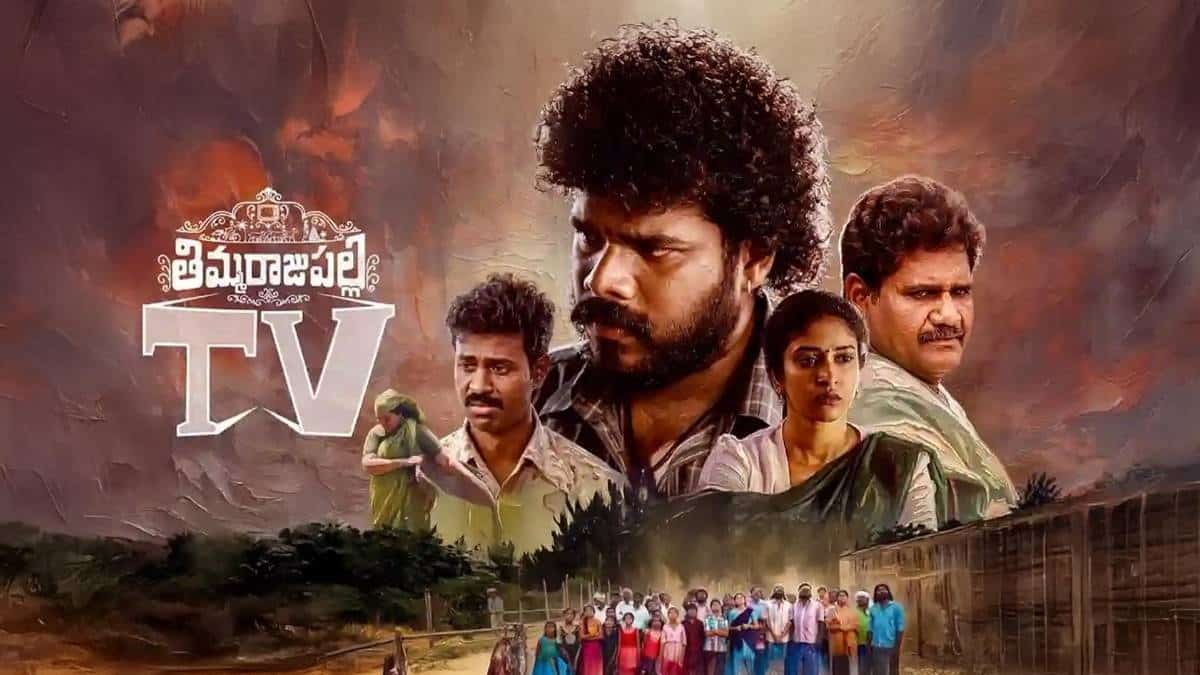
There’s something rare and refreshing about a Telugu film that dares to slow down, look inward, and find drama in the simplest of things — a stolen television in a 1990s village. Thimmarajupalli TV arrives as a gentle but confident reminder that not every story needs grand spectacle to leave a lasting impression. Produced by Kiran Abbavaram and directed by debutant V. Muniraju, this period drama wears its heart proudly on its sleeve. Set in 1996, it captures a time when a single television set could unite an entire village — and divide it just as quickly.
With fresh faces Sai Tej and Veda Jalandhar leading the charge, Thimmarajupalli TV is a film built on warmth, community, and the quiet beauty of simpler times. It stumbles in places, but its soul is undeniable.
Thimmarajupalli TV is a sincere, nostalgic rural drama grounded in a genuinely original premise. Backed by earnest performances, atmospheric cinematography, and a warm background score, it offers a heartfelt slice of 90s Telugu village life. A perfect watch for those who love rooted, community-driven stories.
Language: Telugu
Age Rating: U/A
Genre: Period Drama, Rural Family Drama
Director: V. Muniraju
Release Date: April 17, 2026
The Plot: A Stolen TV, a Village on Trial
At its heart, Thimmarajupalli TV is a whodunit wrapped in nostalgia. Set in the fictional village of Thimmarajupalli in 1996, the story follows Satish (Sai Tej), a lovable petty thief who is in love with Sharada (Veda Jalandhar). Every Maha Shivaratri, Satish arranges a communal television for the village — turning the occasion into a shared celebration that the entire community looks forward to.
Things take a dramatic turn when Rajappa (Pradeep Kotte) becomes the first villager to own a personal TV, upstaging the local head Ramachandrayya (Amma Ramesh) and turning his home into an unofficial community hall. After a heated clash between Satish and Rajappa, the television mysteriously vanishes — and Satish is the prime suspect. With the village council giving him just two weeks to prove his innocence, what follows is a charming, emotionally layered investigation into pride, jealousy, and the ties that bind a community together.
Performances: Sincerity Is the Star
Sai Tej: A Promising Debut Full of Heart
Sai Tej steps into his debut with the quiet confidence of someone who trusts the material. His portrayal of Satish — equal parts mischievous and deeply caring — is the emotional backbone of the film. He shines brightest in the tender scenes with his mother and in the emotionally charged sequences where Satish fights to restore his dignity in front of the village. There’s a naturalness to his performance that bodes very well for his future in Telugu cinema.
Pradeep Kotte: The Layered Antagonist You’ll Warm Up To
Pradeep Kotte gets arguably the most nuanced role in the film, and he makes the most of it. Rajappa is not a simple villain — he is a man of pride and ego, flawed but human. Kotte’s controlled, textured performance adds genuine dramatic weight to the second half and ensures the film’s central conflict feels real rather than manufactured.
Veda Jalandhar and the Supporting Cast
Veda Jalandhar brings grace and warmth to Sharada, and while the romance could have been developed further, her chemistry with Sai Tej has an understated sweetness that works within the film’s gentle tone. Amma Ramesh, Satyanarayana, and Lathish round out the ensemble with lived-in performances that make Thimmarajupalli feel like a real, breathing village rather than a film set.
Direction: A Rooted Vision With Room to Grow
Debutant director V. Muniraju demonstrates a genuine love for the world he’s created. His choice to build an entire film around the emotional significance of a television in a 1990s rural community is bold and original — and for the most part, he executes it with sincerity and warmth.
Where Muniraju truly excels is in the communal scenes — the Maha Shivaratri gatherings, the village council sequences, the quiet domestic moments that make Thimmarajupalli feel alive. The second half demands more urgency, and Muniraju does lean into a slightly uneven pace there, but his instincts are always in the right place. This is a director with a clear voice, and with tighter scripting on his next project, he is one to watch closely.
Technical Brilliance: Where the Film Truly Shines
Cinematography: The Village as a Character
Akshay Ram Podishetti’s camera work is one of the film’s greatest strengths. The muted, golden-toned frames of rural Andhra Pradesh in the 1990s feel authentic and evocative. He treats the village not merely as a backdrop but as a living, breathing character — every dusty lane and thatched roof contributes to the film’s immersive nostalgia.
Music: Quiet, Effective, Memorable
Vamsikanth Rekhana’s background score is the kind that you feel rather than consciously notice — which is exactly what a film like this needs. It swells gently in emotional moments and steps back during dialogue-driven scenes, never competing for attention but always elevating the mood.
Production Design: 1996 Brought to Life
The art department deserves a special mention for faithfully recreating mid-90s rural Telugu life — from period-accurate television sets and clothing to the architecture and interiors of village homes. The production values are neat and cohesive, giving the film a texture that feels genuinely researched and lovingly crafted.
Strengths and Minor Weaknesses
What Works Magnificently
- Genuinely original nostalgic premise — A television as the centre of village life is a fresh, relatable idea
- Pradeep Kotte’s standout performance — Nuanced and emotionally compelling
- Atmospheric cinematography — Rural 1996 Andhra brought to life beautifully
- Warm community sequences — The communal TV-viewing scenes are the film’s emotional highlight
- Sincere debut from Sai Tej — A natural performer with strong instincts
Where It Could Improve
- Second half pacing could be tighter
- The romance between leads needed more screen time and depth
- A few supporting characters feel underwritten
Final Verdict: 4/5 Stars ⭐⭐⭐⭐
Thimmarajupalli TV is the kind of Telugu film that reminds you why rooted, human stories matter. It does not chase spectacle or formula — it simply tells a story about a village, a television, and what both mean to the people caught between them. In doing so, it captures something genuinely rare: the feeling of a shared memory.
Sai Tej and Pradeep Kotte lead with sincerity. V. Muniraju directs with heart. And Akshay Ram Podishetti frames it all with the warmth of a faded photograph you find tucked inside an old album. This is not a perfect film — but it is an honest one, and in today’s cinema landscape, that counts for a great deal.
For those who grew up in 90s Telugu households, or for anyone who loves the quieter, more intimate side of Indian cinema, Thimmarajupalli TV is well worth your time.
What is the age rating of Thimmarajupalli TV?
Thimmarajupalli TV carries a U/A certificate, meaning it is suitable for all audiences with parental guidance advised for younger children.
Can I watch Thimmarajupalli TV with kids?
Yes, absolutely. The film is a clean, family-friendly rural drama with no adult content, graphic violence, or objectionable material.
Is Thimmarajupalli TV based on a true story?
No, Thimmarajupalli TV is a work of fiction.
Who directed Thimmarajupalli TV?
The film is directed by V. Muniraju, who also served as the film’s editor.
